Wednesday, February 25, 2015

Miraculous Migrations

Forget winter.

Yup, I'm officially done with winter. I'm outta here! Me and Mr. Nature Geek are packing our bags and are heading south. We're spending the next two weeks in Costa Rica! (If you thought I was geeking out in Joshua Tree National Park, you just wait.) But before I go, I wanted to get in one last blog post, and what better thing to talk about than migrations? This week, let's cover some migration FAQs:

Why don't all birds migrate?
I was asked this very question just yesterday. Why is it that some birds can tolerate the cold and others can't? The answer is that it's not the cold that drives most birds to migrate, it's a lack of food. Birds that migrate most of time do so because their food becomes scarce or completely absent in the winter. A lack of flower nectar, insects, and fruit, means that the hummingbirds, warblers, and orioles that depend on them must fly south to in order to stay alive. The birds that stick around are those that can always find food to eat. Most of these birds eat seeds or other animals, two kinds of foods that persist in the winter months. Food availability can also vary by region, which affects migrations. For example, while some Canada geese may fly south for the winter, here in Philadelphia, where many waterways remain open and lawns only covered in patchy snow, the geese stick around.

Do any other animals migrate?
Yes, there are many different kinds of animals that migrate! Insects, mammals, fish, amphibians, reptiles, all have representatives that get a move on at some point in their lives. Monarch butterflies have one of the most amazing feats of migration as they fly 3,000 to Mexico to avoid freezing to death. And again, just like with birds, not all migrations are driven by an inability to handle the cold. Caribou of the north and elephants in Africa, one of the last places you'd think of a winter migration, move in order to find food. For elephants, their vegetation doesn't freeze, but rather desiccates during the dry season. Another example, a migration of 1,000 feet to a breeding pond, may not sound like a huge feat to you, but when you're a spotted salamander and everyone wants to make a meal out of you, it's a pretty big deal!

Are all migrations southward?
Migrations occur in all dimensions. The largest migration on the planet occurs in the ocean, where animals that dwell in the deep come to the surface under the safe cover of night in order to feed. In the Rocky Mountains, big horn sheep and mountain goats move from the mountain tops into the valleys in the winter. And salmon are known for their migrations upstream in order to spawn.

What is the longest migration?
That record belongs undeniably to the arctic tern. This bird, hardly more than a foot in length, flies from Greenland to Antarctica in winter and back again in summer. Not only that, but arctic terns don't even fly a straight path between their destinations. Instead, they zigzag in order to take advantage of air currents so that they do not fly into the wind. This makes for a one-way migration of 22,000 miles! And because the arctic tern can live for around 30 years, the amount of flying it does in its lifetime can equal three trips to the moon and back. Fly on little dude, fly on.

I'm thankful that my personal migration to Costa Rica won't take nearly as much time as that of the arctic tern. We all know how hard it is to redeem frequent flyer miles anyway. I shall return in two weeks with stories and photos from a warmer climate so that you can migrate vicariously!

Thursday, February 19, 2015

The Cost of Wildlife as Pets


Working in my job, I get to interact with a variety of incredible animals. On a daily basis I can talk to a tortoise, converse with a corn snake, vocalize with a vulture, and chat with a chinchilla. I also am able to observe the wild animals that dwell on the property of the nature center. But it's not always fun and happy stories. This week was one of those harder days. 

I received a call about an elderly gentleman who was getting ready with his wife to move from their home of 30+ years into an assisted living facility and needed to find a home for his pet bird. Only this was no parrot or canary, this was a grackle, a wild songbird native to much of the United States. I was told the man had found it as a baby and decided to raise it himself and keep it as a pet. I was unsure what I would find when I walked into the house, but had prepared myself for both the best and the worst. 

What I found when I walked into the kitchen was this:

Here was a bird that was born in the wild, and had spent the 7 years of his life in this small, dirty cage. The gentleman thought he was doing the right thing, he had found the bird young and alone and thought it was abandoned or orphaned. He cared for the bird, gave it a home, and food and water. Unfortunately, the cage was too small, and there was no place in the cage where the bird could turn around without brushing his feathers against the metal bars. In addition, although the man knew that grackles are omnivores and need both animal protein and plant-based foods in his diet, instead of eating insects and seeds, the grackle was fed fruit, canned beans, scrambled eggs, and spam. All of this took a toll on the grackle's body and a bird that should look like this:
instead looked like this:
The malnutrition, cramped cage, and inability to bathe (his water was offered in a coffee mug) left his feathers tattered, oily, and dull. 

When we find a wild animal, it's easy to fantasize about how neat it would be to have that animal as a pet in our home. But before you take home that baby bird, rabbit, or box turtle you just scooped up in your hands, take a moment to think about it from the animal's side. If you keep that animal as a pet, it will never return to its home, it will never find a mate, and never rear young. And for some species like the eastern box turtle, whose numbers are in decline, the loss of even one breeding adult can have a significant impact on local populations. Instead of taking an animal into your home, perhaps instead think of ways you can support the animal in its home. You could turn your backyard into a wildlife habitat (look for ideas here, here, and here!), support a national organization like The Nature Conservancy or your local nature center (like Briar Bush!) through donations or by volunteering. Keeping wild animals wild is the only way to ensure we continue to be inspired, amazed, and comforted by their presence for years to come.

So what happened to the grackle? He was taken to the Schuylkill Center Wildlife Rehabilitation Clinic (another great cause to donate to!) where he was given a larger cage and a proper diet. There it is hoped that he will molt his tattered old feathers and replace them with the feathers that will return him to his natural beauty. Because he has been in captivity for so long he cannot be released into the wild, but he will be given a good quality of life under the care of knowledgeable professionals. He just may come to live with me at Briar Bush once he's healthy enough and teach others about helping wild animals in their own homes.

For more information on what you should do if you find a wild animal that you think needs help, read my post, "Oh Baby!"

Wednesday, February 11, 2015

Five Shades of Grey

Valentine's Day may be this Saturday, but I have a feeling there are going to be a lot of couples and singles alike celebrating a day early with the release of the movie Fifty Shades of Grey. And for you kids reading who are wondering about this movie that all the adults keep talking about, let me explain: it's a movie about grown ups coloring pictures of people kissing using just grey crayons. Really boring stuff with lots of cooties that you have no interest in asking about any further. Now go make mommy or daddy a cocktail while they read Auntie Nature Geek's blog.

Today I thought I'd pay my own tribute to this monochromatic movie by highlighting the love lives of five grey animals. Let the science voyeurism [dramatic sexy pause] begin.
Dolphins

Dolphins are one of only a select few animals that are known to mate for recreational purposes, that is to say mate when a female is not in heat. Males and females will mate all year, but what's more is males will mate with each other as well. Now that's a bromance. Both male and female dolphins will stimulate themselves on each other, other animals (poor sea turtle), and inanimate objects. Some divers report being "raped" by dolphins, but really it's akin to nothing more than a dog trying to hump your leg. It's just this dog is really, really big, grey, and rubbery. 
How you doin'?

Why do they do it? Some may be quick to say "well it feels good," but it's not as simple as that. Many dolphin researchers refer to mating as a "socio-sexual behavior," which means that they use it to form and strengthen bonds. Bonobos, a primate that is a close human relative, also engage in socio-sexual behavior. For these animals, sex is often described as serving the same purpose as a handshake in humans. 

Don't think I'll be trying that move at my next business meeting.


Silverfish
I know many of you, like Mr. Nature Geek, cringe just at the mention of silverfish. These small, wingless insects are capable of massive household destruction of books, starchy food, clothes, and carpeting. They are exceptionally good at living with humans and making more of themselves. When a future Mr. and Mrs. Silverfish meet, they partake in a three part courtship ritual that can last for up to 30 minutes. In the first part, the couple face each other and touch their vibrating antennae, their version of small talk. In the second act of our lovers' tango, the male plays hard to get and runs away, and the female does the chasing. Once she catches Mr. Right, they stand side by side, and the male vibrates his tail. The male releases a packet of sperm onto the ground--this may sound a bit premature to humans, but internal fertilization is a bit too kinky for the silverfish. Instead the packet is absorbed by the female's ovipositor, a tube located at the end of her abdomen.

By the way, one unrelated neat fact about the silverfish that I can't leave unmentioned is the frequency of its molts. Usually insects shed their skin only as they grow before reaching maturity. However in silverfish, they continue to shed their skin as adults, molting up to 30 times in one year. Couple that with a lifespan of 2 to 8 years and that's a lot of wardrobe changes!


Marine Iguana
When the breeding season rolls around, male marine iguanas establish territories in which to strut their stuff called leks. Until recently lekking was not thought to occur in reptiles, only in other types of animals such as insects, birds, and mammals. Female marine iguanas travel from lek to lek, carefully inspecting each male. These ladies may be some of the choosiest of all lizards, evaluating their studs based on size, activity level, ornamentation (those awesome crests you see in the photo), body condition, and even how many ticks and mites he has. I mean really ladies, is there no bigger turnoff than ectoparasites on your man? Surprisingly, what is not used as a way to judge males is their coloration, which gets pretty spectacular in the breeding season.
In research conducted by Dr. Martin Wikelski, male marine iguanas were painted all sorts of hues to see if females had a color preference in their mates. The ladies cared not in the slightest. Dr. Wikelski's team hypothesizes that the coloration that appears in male iguanas is due to pigments building up in their skin from their diet of algae. When not breeding, a male iguana sheds his skin and this pigment on a regular basis. But when it's time to impress females, every bit of energy that can be spared goes into courtship, and they stop shedding their skin. So a male marine iguana's coloration is not an indicator of superior health or diet, but rather of his devotion to his sexy craft.

Grey Wolf
Like many males, the males of the grey wolf worry about competition from rivals. He may be the top dog and have won the female's attention, but as soon as he leaves, what's to stop another male from coming in and mating with her? Then it could be the rival's pups that the female raises, denying him the chance to pass along his genes. In grey wolves and other members of the dog family, nature has come up with a clever solution to eliminate the competition. When a male mates with a female, his penis swells swells and her vagina contracts, which causes the two to be literally stuck together for up to 30 minutes. This is just long enough for the male's sperm to fertilize the female, without the interruption of competitors. Five minutes into this "dog knot," the male twists himself around (ow) and the couple stay end-to-end for the duration of their time together, hoping they don't need to run anywhere fast. Or in opposite directions.

Peanut, the White-Faced Cockatiel
It would be remiss of me to do a whole blog on the love life of grey animals and not mention the strange habits of my very own grey bird. In addition to dolphins, it is known for many species of animals to masturbate, both in the wild and in captivity. When my beloved Peanut became sexually mature, he chose for his first "girlfriend"...a tennis ball. Now, I want to stop for a moment to let that imagery sink in. Yup, Mr. Nature Geek and I spent a lot of time laughing our butts off as we watched this little parrot try to climb on top of a rolling tennis ball. The best part was when the tennis ball would roll backwards and hit him and Peanut would give it a very angry PECK.
Baby Peanut, pre-towel traumatization.

But the fun doesn't stop there. As new bird parents 11 years ago, Mr. Nature Geek and I had read that it is a good idea with young birds to train them not to be afraid of a towel. The idea is that it makes vet appointments less stressful when the bird is wrapped up in a towel during examinations. So I took a towel and would drape it over Peanut, gently touch him with it, and otherwise attempt to acclimate him to it. Apparently what I did was forever screw up his birdy brain and today whenever he sees something clothlike and white, he wants to both intimidate it and mate with it. Ah, birds.

And yes, his song of intimidation is the theme to the Andy Griffith Show. 

They may be grey, but the love lives of the dolphin, silverfish, marine iguana, grey wolf, and Peanut are quite colorful. However you spend Valentine's Day this year, I'm glad you chose me to be your method of foreplay. Let's meet here next week for another secret rendezvous and get our geek on. Awww yeahhh.

Thursday, February 5, 2015

Walk this Way

I may be a geek, but I do like to shake my groove thing on the dance floor. To indulge my desire to boogie oogie oogie, I go to Zumba every Wednesday.
Shout out to my fabulous Zumba instructor, Sandy Castro!

Zumba is a great workout that moves your whole body, from your legs and feet to your arms and hands, and yes, there's a whole lotta booty shaking as well. We may not give much thought to how we move on a daily basis, but when you stop to watch other members of the animal kingdom, you'll see there's more than one way of getting around. 

Flatfooted: Plantigrade
When an animal walks with their foot bones flat on the ground, it is known as plantigrade. This is how humans walk and why I prefer my comfy hiking boots to heels--it's how we were made to walk, and after all, who is the Nature Geek to argue with nature? Plantigrade animals enjoy being the most efficient long distance walkers and an increased stability with their flat feet. Going back to my footwear example, who is easier to push over, a geek in boots or a model in stilettos?
That's gonna hurt tomorrow.

Squirrels are an example of a plantigrade animal. They have big, flat back feet which were just made for scaling trees and gripping tightly onto branches. But watch a squirrel closely and you'll discover something incredible about those feet. Watch the video clip below to find out!

The Ballerinas: Digitigrade
Next, we have the animals that are the true prima ballerinas. These animals always walk on their toes, known as digitigrade. Examples of digitigrade animals include cats,
dogs,
and birds.
Many people at one time or another have pondered about birds' knees bending backwards and why they do so. The answer is that what is commonly regarded as the "knee" is actually the bird's ankle! The bones that come after the bend are really super long foot bones, and then of course, the toes. A bird's knees are close to the body and what we refer to as the "drumstick." So a bird's knees don't bend backwards at all, what you're seeing is an ankle joint that bends just like your own.

So what's the advantage of walking on your tiptoes all the time? First of all, digitigrade animals have the ability to walk much more softly than we flatfoots. Also, by having less contact with the ground, these animals increase their stride length and speed. The cheetah, the fastest land mammal, could never run as fast if its feet were plantigrade. But even though the cheetah may be the fastest, its speed is only short lived. If you want to be fast and efficient, you've gotta have even fancier feet. 

Which leads us to...

The Showoffs: Ungulates
You thought an animal walking on its toes all the time was an accomplishment? Try walking on just your toenails! That's what it means to be an ungulate, or unguligrade. The toenails on these animals have evolved to be thick and strong, and we call them hooves.

The fastest ungulate in the world is a hometown hero, the pronghorn antelope of North America.
"CMR Pronghorn USFWS" by USFWS Mountain-Prairie 

The story of the pronghorn's speed has always been one of my favorites. In the pronghorn's native range in the western United States, there are no predators that come close to rivaling its speed. So why are pronghorns so fast? Because during the Pleistocene the American cheetah roamed the plains. Today the American cheetah may be gone, but the pronghorn antelope and its speed live on.

Like with digitigrade animals, having a further reduction in toe bones in contact with the ground increases stride length and speed. So why wouldn't all digitigrade animals be unguligrade? The increase in speed comes with a trade off, decreased stability. Not only because of the tiny amount of surface area in contact with the ground, but also because of the lack of grip of hooves when compared to toes and feet. But try telling that to these dam goats.
 Click here for more about these unbounded ungulates.

Look Ma, No Hands!
I can't do a post on how animals move without giving some much due respect to snakes. After all, they don't have feet, toes, or even hooves, they manage to get along at some amazing speeds and even climb using only their belly. How do they do it?

Zumba is a great way for me to get up off my butt and get some exercise in the doldrums of winter as I wait for the warm days of spring to return. Whether you move your feet, toes, hooves, or do the worm (or snake) on your belly, do some moving this weekend and think about the different ways animals move while you're at it!

Thursday, January 29, 2015

A Day in the Life: Vietnamese Walking Sticks

Yesterday was one of those days in which I found myself watching the 1998 version of Godzilla on AMC just because it was on and I was in the mood to mock a bad movie. (If you haven't seen the movie and for some reason are planning on it, spoilers ahead.) At one point in the movie, our hero biologist, Matthew Broderick, uses a home pregnancy test to discover that Godzilla is a "pregnant" male, explaining that he can reproduce without a mate.


"Do I look bloated to you?"

While using a home pregnancy test on a giant lizard is bad science, and calling a lizard that lays eggs "pregnant" bad grammar (the correct term is gravid), the idea of an animal reproducing without a mate is not only possible, but occurs in many species. An example of such lives at Briar Bush Nature Center, and is called the Vietnamese walking stick.
In the wild, Vietnamese walking sticks do reproduce sexually, with males and females, but when you are a small insect in a large rainforest, a mate can be hard to come by, especially when your lifespan is a short 8 months. (And you thought your mother pressuring you to find a spouse in 22 years was rough.) In the absence of a male, female walking sticks are able to reproduce by parthenogenesis; they lay unfertilized eggs that develop into clones of the female. Although this kind of reproduction does not allow for adaptations to changing conditions in the environment, it does allow the female to reproduce and give her bloodline a little bit longer to find a mate.

In captivity, there are no male Vietnamese walking sticks! Every single walking stick you'll see is a female. Thanks to parthenogenesis, it's easy for me to keep my population of walking sticks going. Once a female has reached about 6 months of age, she starts laying eggs, and then 2-4 months later, an adorable little clone emerges.
*singing* "My Little Cloney, sweet little cloney..."

The only part of the Vietnamese walking stick life cycle that I have a hard time with is raising the eggs. They need just the right humidity in order to hatch. In order to monitor the eggs every day, I raise them in my house, in a little plastic container. The majority don't hatch, but when each female lays 20-40 eggs, that's not a bad thing. On the days that an egg hatches, it's like waking up to Christmas morning. A baby walking stick has magically appeared in the container! Squeeeeee! And in just 6 months, that little Vietnamese walking stick nymph little will lay her own eggs and the cycle will begin all over again, no pregnancy test needed.

Thursday, January 22, 2015

Revealing the Mystery of Skulls

I've been writing on and off for 6 years now and came to the realization this week that I have yet to write about one of my ultimate geeky interests: skulls! I love dead stuff. Skulls, bones, carcasses, and even study skins (a kind of taxidermy), I do it all. You give me a skull, and I will geek on about it at length. At Briar Bush's annual fundraiser a few years back, there I was in my best dress and holding a horse's head:
Don't let the fancy dress fool you, I am not a fashionable person (I just say I clean up nice). 
Notice I am still wearing my Timex watch at a formal event.

Why do I love dead stuff so much? I think it's because there's an element of mystery to it. Who does this bone belong to? How did the animal die? How old was it? What was its last meal? Was it healthy? Today I want to share with you some of the mysteries that can be examined by looking at animal skulls. A careful look at an animal's skull can reveal a great deal about its former life. 

What Big Eyes You Have!
The eye sockets on this domestic cat reveal its nocturnal habits. Nocturnal animals have larger eyes than their diurnal counterparts, which is reflected in the skull. This isn't always clear, raccoons for example don't have nearly as proportionally large eyes as cats, but if you come across a skull with big ol' sockets like this, it's a safe bet you have a nocturnal animal.

Biting Power
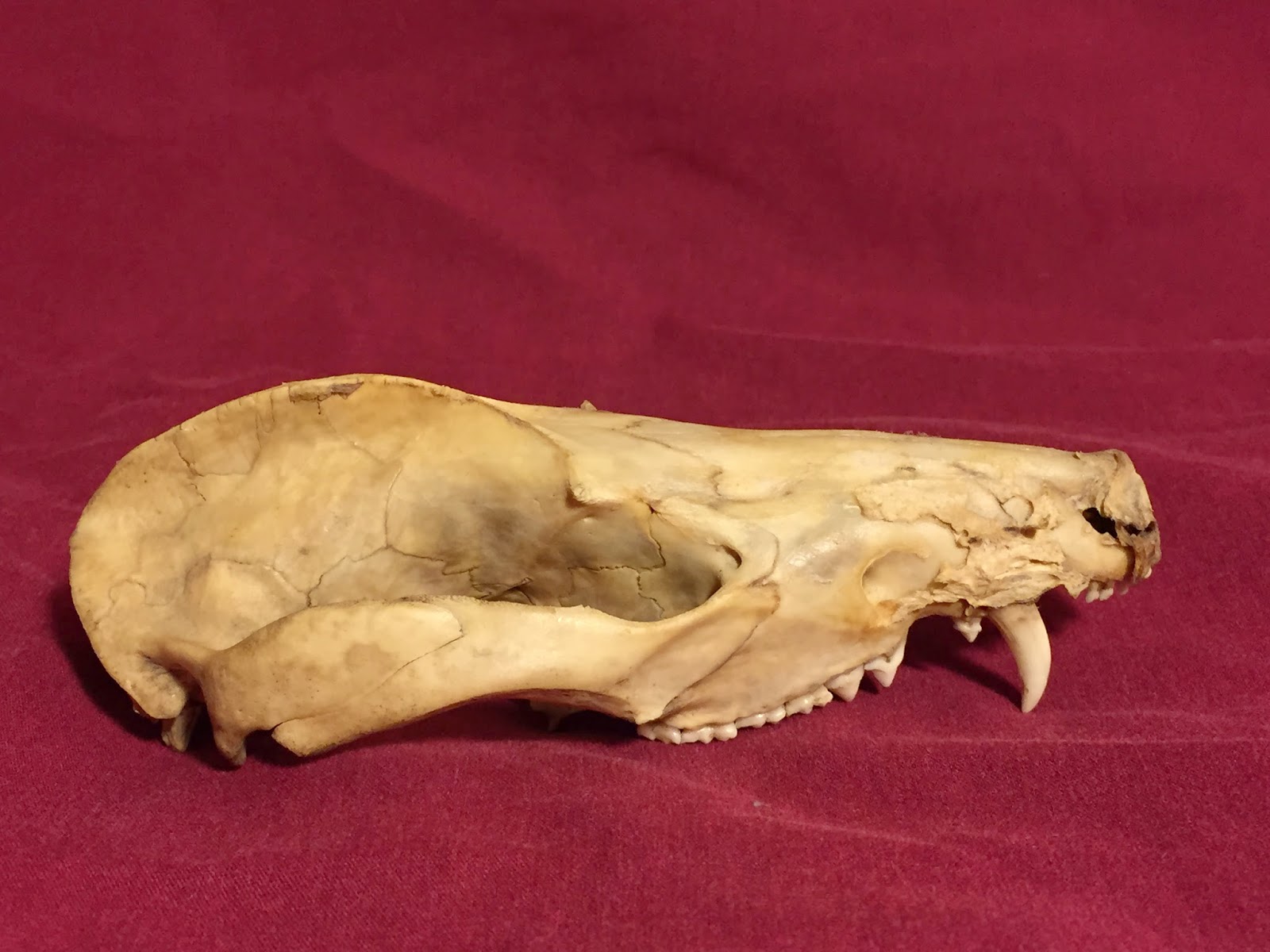
The first thing I notice on this skull is not those fangs on the front, but something even more important. See that large, upright, flat projection on the back of the skull, on top of the brain case? Whenever you see smooth, flat surfaces on a skull, it is for muscle attachment. The bigger the surface, the more muscle that can be attached. The name for the projection on the top of the head is called the sagittal crest and it provides attachment for the muscles that go from the head down to the jaw. In other words, the bigger the sagittal crest, the stronger the biting power. Who is this critter, that has a strong bite to back up those pointy teeth? 
Henry may be cute when he's sleeping, but you do not want to be bitten by him.

That is none other than the Virginia opossum, who, if you remember from my previous post on opossums, has the most teeth out of any land animal in North America. The opossum has 50 teeth, while we humans possess a mere 32. 

With your new found knowledge, take a look at this next skull and I'll bet you can tell me right away what kind of turtle you're looking at:
If you said "snapping turtle," you're exactly right. Specifically this is a common snapping turtle. Reptile skulls may not have the same anatomical features of mammal skulls, but the flat and smooth rule still applies.

Stories of Teeth
Teeth are the best way to tell what an animal eats. If all the teeth are razor sharp like on that cat skull, that animal is a carnivore. If there's some sharp teeth in the front and molars in the back like Henry the opossum, the animal is an omnivore, one that eats plants and meat. If an animal has teeth like these, with just flat molars for grinding up food:
you have a herbivore. This skull belongs to a white-tailed deer. Hunters often will age the deer they kill by looking at the wear on the teeth of the deer's jaw. Let's take a close look at the teeth on this deer's jaw.
When aging a deer, the teeth are referred to as being numbered from right to left, 1 through 6 (each tooth has 2-3 cusps, so don't let that throw you off). This website is the best one I have come across for aging. Take a look and see if you can figure out the age of this deer! Don't worry, I'll wait. Did you notice the worn last cusp on the 6th tooth and the blunt crests on tooth 4 and 5? This deer is between 3.5 and 4.5 years old.

Or is it?

The group that developed this method of aging did so using a captive population of deer being fed an artificial diet. They did not take into account deer that browse in areas with sandy soils or that eat grasses with a higher silica content, both of which would cause a deer's teeth to wear at a faster rate. Scientists have concluded that aging a deer by its teeth can really only tell you if it is older or younger than 2.5 years, which is the time when the deer acquires its permanent 1-3 teeth.

Ok, let's take a look at one last mystery. What if you don't have a skull, you don't have a set of teeth, but you have just a single tooth alone?
What can you possibly get from one tooth? Quite a bit, as it were! This pointy tooth is conical, not flat on the sides. This means that this tooth is only made for holding prey, not for chewing it. When we look at the bottom of the tooth:
we notice that it's concave, that there are no roots to anchor this tooth into the jaw. Now we know that we 1) have a predator that 2) doesn't chew its food and 3) has teeth that are meant to fall out and be replaced easily. Couple that with where you would have found this tooth, in a freshwater ecosystem in Florida and can you figure out who this tooth belongs to?
Down the hatch, blue crab.

The American alligator. It's amazing what you can figure out from just looking at a single isolated tooth!

By looking at details on an animal's skull, such as eye sockets, places for muscle attachment, and teeth, you can discover all sorts of clues about an animal's former life. This is why I love dead things so much, I love the opportunity to exercise my geeky brain and do some critical thinking. The next time you come across a skull or animal bone, stop for a moment and see what you notice. Then do me a favor and send me a photo on my Facebook page--I'd love to see it too!

Can't get enough dead stuff? Check out my latest post, Revealing the Mystery of Bones!

Thursday, January 15, 2015

A Day in the Life: Tarantula Sexing and Spider Porn

*wipes off dust*

Well, what do we have here? It appears to be some sort of...blog. Hey, someone should really update this thing, I mean geez, what kind of a person doesn't update their blog in 9 months? Oh wait. That would be me.

Right.

LET'S DO THIS THING.

Welcome to the new and improved Nature Geek blog! In addition to the various longer posts that I have traditionally written in the past, I will be featuring new posts called "A Day in the Life" in which I share exploits from my job as an Environmental Educator and Animal Curator at Briar Bush Nature Center in Abington, Pennsylvania. Many of you have commented that you'd like me to share more of these stories, and I am happy to oblige.

At Briar Bush, we have a Mexican red leg tarantula named Ginger, whom I acquired from her former owner when she was less than a year old. One of the first things I wanted to do when I got her was find out if she was a male or female, because not only do female tarantulas get larger, but they also live four times as long as males. Sexing a tarantula, especially a juvenile, is a difficult thing to do. One of the ways to do it is to examine a tiny little arrangement of hairs on the underside where the cephalothorax (what most would refer to as the "body") meets the abdomen (what many call the "butt" of a spider). If the hairs swirl in one shape, it's a male, if it swirls in another shape, a female. Now try doing this after you've grabbed a cranky tarantula around its waist and are holding it close to your face as it has its cranky fangs spread wide open. You get the idea. Fortunately, this tarantula molted, or shed its skin, within a couple weeks of acquiring it, so I was lucky enough to have a non-moving, non-bitey skin to use for sexing. I examined the hairs very carefully and was pretty sure I saw the hairs swirling this way and not that, so the tarantula was declared a female and named "Ginger." 


Young Ginger as a 2" spider. Adult females reach up to 4" in body length, with a 6" legspan.

Over the past two years, Ginger grew and molted a total of 4 times, the most recent molt being two weeks ago. When tarantulas molt, it's a good idea to leave them alone for 7-10 days so that their soft exoskeleton can harden properly. On Wednesday I picked Ginger up and noticed that the tips of her pedipalps were shiny. The pedipalps are what look like short 9th and 10th legs on the front of a spider's body; you can see them in the photo above. Although a spider moves them as it walks, they are actually mouth parts and not legs, used for holding prey as the spider feeds. I was worried that somehow something had gone wrong and that perhaps the tips of Ginger's pedipalps had broken off during her last molt. I also noticed projections on her front legs where her red stripes were:

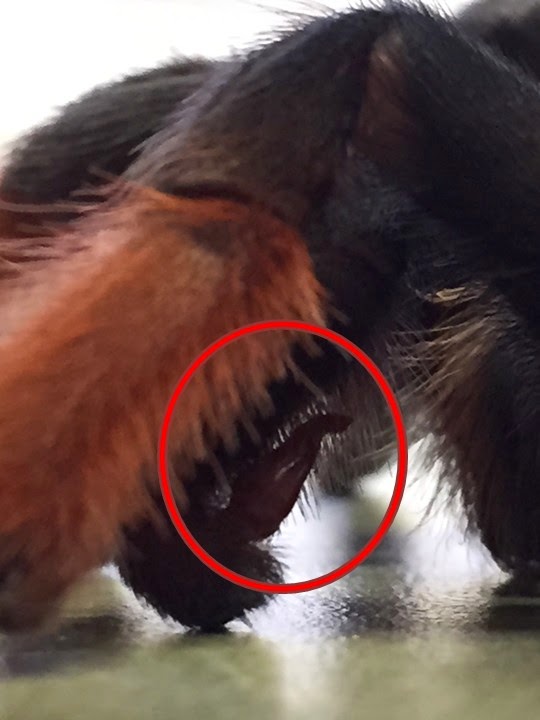
And then my geeky brain kicked in: this wasn't an injured spider, this was a male spider! Yup, Ginger was a male! The projections in the photo are called tibial spurs and are used to hold a female spider's fangs up while a male attempts to mate with her. After all, if he's not careful she'll make a meal out of him. And those shiny tips on the pedipalps?

The scientific term is an embolus (plural: emboli) but are more commonly referred to as "boxing gloves." However the boxing gloves in this case are not used for fighting other males as the name might suggest, but rather for impregnating a female by sticking one in an opening on her abdomen. Essentially you're looking at a spider's testicles right now, you dirty, dirty, reader you.

This new discovery led me on a classic Nature Geek quest for more knowledge. After conducting a thorough search on the proper terminology for the tibial spurs and emboli, I had to see them in action. Yup, I went searching for sex videos. I love that this is a legitimate part of my job, searching for sex videos and talking to my coworkers about how various living things have sex. In my search, I came across this video of the courtship ritual of the largest species of spider in the world, the Goliath bird-eating tarantula. Note how the male uses those tibial spurs on his legs to hold up the female. Also note how bapping your potential mate's head repeatedly is equivalent to sexy talk in tarantulas. (The courtship begins at the 2:00 mark)

So there you have it, Ginger is now a male (we think we are going to rename him "Rusty") and now whenever I use him for a program in front of a bunch of preschoolers I won't be able to not look at his junk. Yet another perk of my job.