Showing posts with label American alligator. Show all posts

Thursday, May 21, 2015

Revealing the Mystery of Bones

In January, I wrote "Revealing the Mystery of Skulls," in which I shared how a closer look at an animal's skull can reveal mysteries about its former life. Many of you commented on how much you enjoyed that post, and so today I thought I would bring to you a second helping of calcified goodness. This time, we'll be taking a look not at skulls, but other animal bones. Although other bones may not seem as exciting as skulls, they too can tell stories about an animal's life and death.

Dive! Dive!
These are what human rib bones look like. No real surprises here, a series of thin, curved bones, designed to protect your most important organs, like your heart and lungs. What is surprising and kinda creepy is that I got this image from Pintrest, where these real bones are for sale. Just smile and walk away, Katie, pretend you didn't see anything and avoid eye contact. Now take a look at this rib bone:
Look at how thick it is! The thickness is disproportionate to the size; this is not some dinosaur or elephant bone. So whose is it and why is it so thick? This is the rib bone of the Florida manatee, aka "sea cow."
Manatees are slow moving marine mammals that spend their days at the bottom of waterways, grazing on sea grasses. If a human wanted to lay on the bottom of the Gulf of Mexico, they would need to wear scuba dive weights to help them descend. Manatees have their dive weights built right in! Their super heavy and dense skeletons make it much easier to bob along on the bottom of the beautiful briny sea (extra points if you got the reference!). And if you're wondering how a manatee's body counteracts the weight of its skeleton in order to surface to breathe, manatees have extra long lungs along their back to aid in buoyancy.

Two Clues in One
Here we have another mystery bone, this one with two stories to tell. First, let's take a closer look at that hole on top. 
Unlike the manatee's solid rib, this bone is hollow, meaning it can only belong to one kind of animal: a bird! Almost every single aspect of a bird's anatomy comes back to weight reduction in order to achieve flight. Bird's skeletons are hollow, but still have criss-cross struts for reinforcement, just like an airplane's wings. This particular bone came from the wing of a brown pelican. Now let's look at another clue by zooming in on the left side of the bone.
See all those scrape marks? Those aren't a normal feature of this bone, they came after the pelican died and its tissues decomposed. These are chew marks from a rodent! In the wild, animals don't have Flintstones vitamins in order to get the calcium they need, they get it from eating bones. This not only gives the chewer calcium, but also helps break down and dispose of animal carcasses. Rats, mice, squirrels, even deer and pigs will all chew on bones and leave their telltale clues behind.

Super Sensors
Another bird bone, this one is the beak of a roseate spoonbill, a gorgeous resident of Florida that is often mistaken for a flamingo due to its bright pink feathers.
Spoonbills wave their beak back and forth in the water while holding it slightly open in order to find their food. Instead of relying on their sense of sight to tell them when to snap their bill shut, they instead use a keen sense of touch. When we look closer at the underside of this spoony's beak, we can see hundreds of small holes where nerves permeate it, especially at the tip.
 Fish don't stand a chance.

A Successful Defense (but he still died anyway)
Strong and sturdy, a turtle's shell is its ultimate defense from predators. The shell is a part of its skeleton, and is the result of widened and fused ribs, which are attached to the central backbone. When a turtle is withdrawn into its shell, it is protected from the bite of most predators, including raccoons, bobcats, and even...alligators. 
Check this out:
On the back of this shell, you'll see three holes, the middle of which even has a scrape mark. And when we look on the bottom of the shell...
Three more tooth marks, complete with scrapes too! This turtle was one baaaad shut your mouth! It survived an attack from an alligator! How do we know it survived? Well unlike raccoons and bobcats, who can still use their paws to claw at a retracted turtle, alligators eat turtles by crushing their shells in their jaws. Because the shell is intact, we know this didn't happen. We also know that the turtle wasn't just swallowed whole because an alligator's stomach is capable of dissolving bone, so this isn't a shell that was pooped out. Just as well too, because this is a big shell and that sucker would hurt on the way out. We may not know what killed this turtle in the end, but we know it wasn't an alligator!

We may think of skulls as the most interesting part of an animal's skeleton, but all bones, no matter how small or mundane-looking, can tell stories of life and death. The next time you find an animal bone, go all CSI on it and see what you can figure out. Just don't sell any human bones you find on Pintrest, ok? That's still creeping me out.


Thursday, January 22, 2015

Revealing the Mystery of Skulls

I've been writing on and off for 6 years now and came to the realization this week that I have yet to write about one of my ultimate geeky interests: skulls! I love dead stuff. Skulls, bones, carcasses, and even study skins (a kind of taxidermy), I do it all. You give me a skull, and I will geek on about it at length. At Briar Bush's annual fundraiser a few years back, there I was in my best dress and holding a horse's head:
Don't let the fancy dress fool you, I am not a fashionable person (I just say I clean up nice). 
Notice I am still wearing my Timex watch at a formal event.

Why do I love dead stuff so much? I think it's because there's an element of mystery to it. Who does this bone belong to? How did the animal die? How old was it? What was its last meal? Was it healthy? Today I want to share with you some of the mysteries that can be examined by looking at animal skulls. A careful look at an animal's skull can reveal a great deal about its former life. 

What Big Eyes You Have!
The eye sockets on this domestic cat reveal its nocturnal habits. Nocturnal animals have larger eyes than their diurnal counterparts, which is reflected in the skull. This isn't always clear, raccoons for example don't have nearly as proportionally large eyes as cats, but if you come across a skull with big ol' sockets like this, it's a safe bet you have a nocturnal animal.

Biting Power
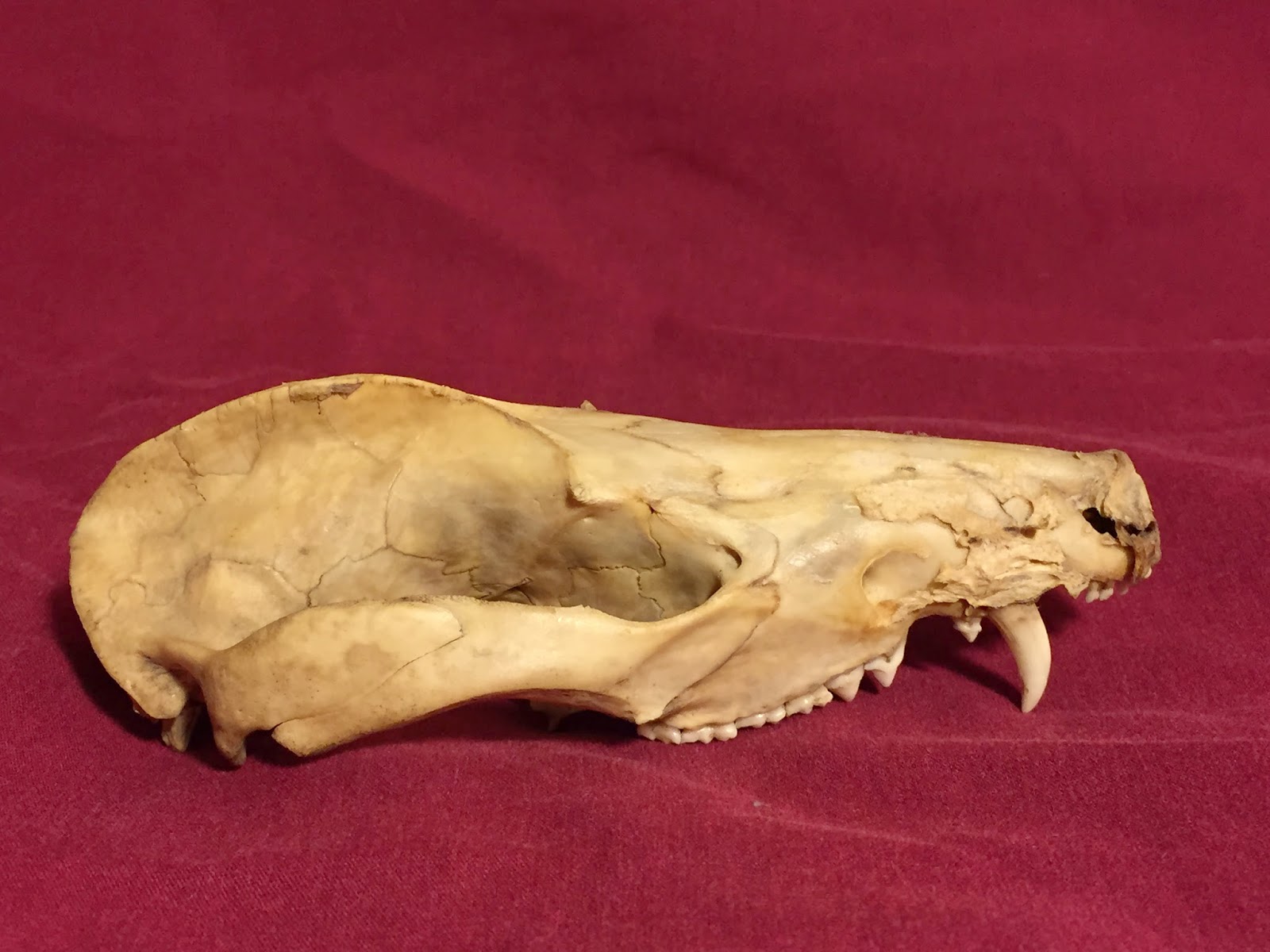
The first thing I notice on this skull is not those fangs on the front, but something even more important. See that large, upright, flat projection on the back of the skull, on top of the brain case? Whenever you see smooth, flat surfaces on a skull, it is for muscle attachment. The bigger the surface, the more muscle that can be attached. The name for the projection on the top of the head is called the sagittal crest and it provides attachment for the muscles that go from the head down to the jaw. In other words, the bigger the sagittal crest, the stronger the biting power. Who is this critter, that has a strong bite to back up those pointy teeth? 
Henry may be cute when he's sleeping, but you do not want to be bitten by him.

That is none other than the Virginia opossum, who, if you remember from my previous post on opossums, has the most teeth out of any land animal in North America. The opossum has 50 teeth, while we humans possess a mere 32. 

With your new found knowledge, take a look at this next skull and I'll bet you can tell me right away what kind of turtle you're looking at:
If you said "snapping turtle," you're exactly right. Specifically this is a common snapping turtle. Reptile skulls may not have the same anatomical features of mammal skulls, but the flat and smooth rule still applies.

Stories of Teeth
Teeth are the best way to tell what an animal eats. If all the teeth are razor sharp like on that cat skull, that animal is a carnivore. If there's some sharp teeth in the front and molars in the back like Henry the opossum, the animal is an omnivore, one that eats plants and meat. If an animal has teeth like these, with just flat molars for grinding up food:
you have a herbivore. This skull belongs to a white-tailed deer. Hunters often will age the deer they kill by looking at the wear on the teeth of the deer's jaw. Let's take a close look at the teeth on this deer's jaw.
When aging a deer, the teeth are referred to as being numbered from right to left, 1 through 6 (each tooth has 2-3 cusps, so don't let that throw you off). This website is the best one I have come across for aging. Take a look and see if you can figure out the age of this deer! Don't worry, I'll wait. Did you notice the worn last cusp on the 6th tooth and the blunt crests on tooth 4 and 5? This deer is between 3.5 and 4.5 years old.

Or is it?

The group that developed this method of aging did so using a captive population of deer being fed an artificial diet. They did not take into account deer that browse in areas with sandy soils or that eat grasses with a higher silica content, both of which would cause a deer's teeth to wear at a faster rate. Scientists have concluded that aging a deer by its teeth can really only tell you if it is older or younger than 2.5 years, which is the time when the deer acquires its permanent 1-3 teeth.

Ok, let's take a look at one last mystery. What if you don't have a skull, you don't have a set of teeth, but you have just a single tooth alone?
What can you possibly get from one tooth? Quite a bit, as it were! This pointy tooth is conical, not flat on the sides. This means that this tooth is only made for holding prey, not for chewing it. When we look at the bottom of the tooth:
we notice that it's concave, that there are no roots to anchor this tooth into the jaw. Now we know that we 1) have a predator that 2) doesn't chew its food and 3) has teeth that are meant to fall out and be replaced easily. Couple that with where you would have found this tooth, in a freshwater ecosystem in Florida and can you figure out who this tooth belongs to?
Down the hatch, blue crab.

The American alligator. It's amazing what you can figure out from just looking at a single isolated tooth!

By looking at details on an animal's skull, such as eye sockets, places for muscle attachment, and teeth, you can discover all sorts of clues about an animal's former life. This is why I love dead things so much, I love the opportunity to exercise my geeky brain and do some critical thinking. The next time you come across a skull or animal bone, stop for a moment and see what you notice. Then do me a favor and send me a photo on my Facebook page--I'd love to see it too!

Can't get enough dead stuff? Check out my latest post, Revealing the Mystery of Bones!