Thursday, January 29, 2015

A Day in the Life: Vietnamese Walking Sticks

Yesterday was one of those days in which I found myself watching the 1998 version of Godzilla on AMC just because it was on and I was in the mood to mock a bad movie. (If you haven't seen the movie and for some reason are planning on it, spoilers ahead.) At one point in the movie, our hero biologist, Matthew Broderick, uses a home pregnancy test to discover that Godzilla is a "pregnant" male, explaining that he can reproduce without a mate.


"Do I look bloated to you?"

While using a home pregnancy test on a giant lizard is bad science, and calling a lizard that lays eggs "pregnant" bad grammar (the correct term is gravid), the idea of an animal reproducing without a mate is not only possible, but occurs in many species. An example of such lives at Briar Bush Nature Center, and is called the Vietnamese walking stick.
In the wild, Vietnamese walking sticks do reproduce sexually, with males and females, but when you are a small insect in a large rainforest, a mate can be hard to come by, especially when your lifespan is a short 8 months. (And you thought your mother pressuring you to find a spouse in 22 years was rough.) In the absence of a male, female walking sticks are able to reproduce by parthenogenesis; they lay unfertilized eggs that develop into clones of the female. Although this kind of reproduction does not allow for adaptations to changing conditions in the environment, it does allow the female to reproduce and give her bloodline a little bit longer to find a mate.

In captivity, there are no male Vietnamese walking sticks! Every single walking stick you'll see is a female. Thanks to parthenogenesis, it's easy for me to keep my population of walking sticks going. Once a female has reached about 6 months of age, she starts laying eggs, and then 2-4 months later, an adorable little clone emerges.
*singing* "My Little Cloney, sweet little cloney..."

The only part of the Vietnamese walking stick life cycle that I have a hard time with is raising the eggs. They need just the right humidity in order to hatch. In order to monitor the eggs every day, I raise them in my house, in a little plastic container. The majority don't hatch, but when each female lays 20-40 eggs, that's not a bad thing. On the days that an egg hatches, it's like waking up to Christmas morning. A baby walking stick has magically appeared in the container! Squeeeeee! And in just 6 months, that little Vietnamese walking stick nymph little will lay her own eggs and the cycle will begin all over again, no pregnancy test needed.

Thursday, January 22, 2015

Revealing the Mystery of Skulls

I've been writing on and off for 6 years now and came to the realization this week that I have yet to write about one of my ultimate geeky interests: skulls! I love dead stuff. Skulls, bones, carcasses, and even study skins (a kind of taxidermy), I do it all. You give me a skull, and I will geek on about it at length. At Briar Bush's annual fundraiser a few years back, there I was in my best dress and holding a horse's head:
Don't let the fancy dress fool you, I am not a fashionable person (I just say I clean up nice). 
Notice I am still wearing my Timex watch at a formal event.

Why do I love dead stuff so much? I think it's because there's an element of mystery to it. Who does this bone belong to? How did the animal die? How old was it? What was its last meal? Was it healthy? Today I want to share with you some of the mysteries that can be examined by looking at animal skulls. A careful look at an animal's skull can reveal a great deal about its former life. 

What Big Eyes You Have!
The eye sockets on this domestic cat reveal its nocturnal habits. Nocturnal animals have larger eyes than their diurnal counterparts, which is reflected in the skull. This isn't always clear, raccoons for example don't have nearly as proportionally large eyes as cats, but if you come across a skull with big ol' sockets like this, it's a safe bet you have a nocturnal animal.

Biting Power
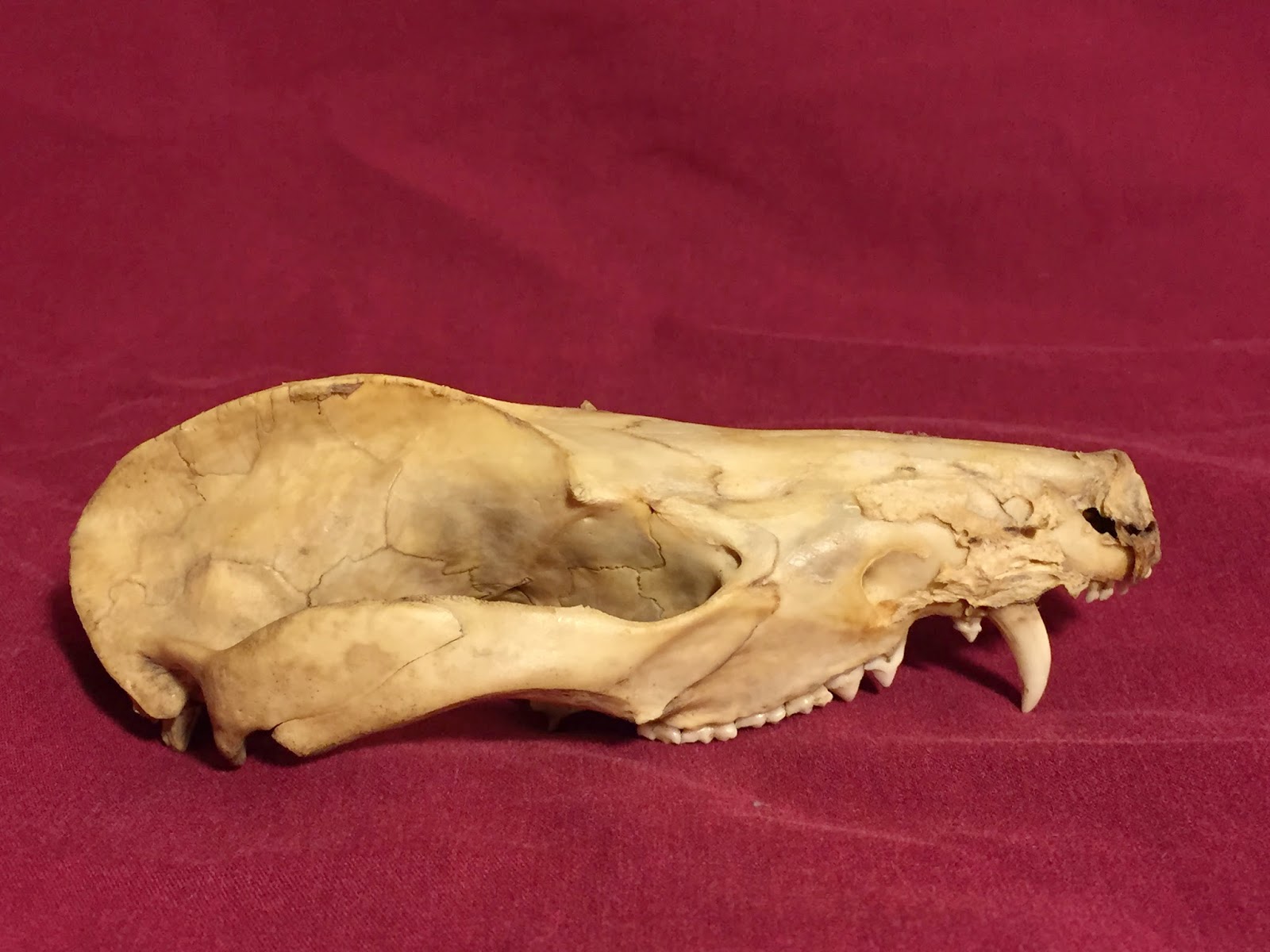
The first thing I notice on this skull is not those fangs on the front, but something even more important. See that large, upright, flat projection on the back of the skull, on top of the brain case? Whenever you see smooth, flat surfaces on a skull, it is for muscle attachment. The bigger the surface, the more muscle that can be attached. The name for the projection on the top of the head is called the sagittal crest and it provides attachment for the muscles that go from the head down to the jaw. In other words, the bigger the sagittal crest, the stronger the biting power. Who is this critter, that has a strong bite to back up those pointy teeth? 
Henry may be cute when he's sleeping, but you do not want to be bitten by him.

That is none other than the Virginia opossum, who, if you remember from my previous post on opossums, has the most teeth out of any land animal in North America. The opossum has 50 teeth, while we humans possess a mere 32. 

With your new found knowledge, take a look at this next skull and I'll bet you can tell me right away what kind of turtle you're looking at:
If you said "snapping turtle," you're exactly right. Specifically this is a common snapping turtle. Reptile skulls may not have the same anatomical features of mammal skulls, but the flat and smooth rule still applies.

Stories of Teeth
Teeth are the best way to tell what an animal eats. If all the teeth are razor sharp like on that cat skull, that animal is a carnivore. If there's some sharp teeth in the front and molars in the back like Henry the opossum, the animal is an omnivore, one that eats plants and meat. If an animal has teeth like these, with just flat molars for grinding up food:
you have a herbivore. This skull belongs to a white-tailed deer. Hunters often will age the deer they kill by looking at the wear on the teeth of the deer's jaw. Let's take a close look at the teeth on this deer's jaw.
When aging a deer, the teeth are referred to as being numbered from right to left, 1 through 6 (each tooth has 2-3 cusps, so don't let that throw you off). This website is the best one I have come across for aging. Take a look and see if you can figure out the age of this deer! Don't worry, I'll wait. Did you notice the worn last cusp on the 6th tooth and the blunt crests on tooth 4 and 5? This deer is between 3.5 and 4.5 years old.

Or is it?

The group that developed this method of aging did so using a captive population of deer being fed an artificial diet. They did not take into account deer that browse in areas with sandy soils or that eat grasses with a higher silica content, both of which would cause a deer's teeth to wear at a faster rate. Scientists have concluded that aging a deer by its teeth can really only tell you if it is older or younger than 2.5 years, which is the time when the deer acquires its permanent 1-3 teeth.

Ok, let's take a look at one last mystery. What if you don't have a skull, you don't have a set of teeth, but you have just a single tooth alone?
What can you possibly get from one tooth? Quite a bit, as it were! This pointy tooth is conical, not flat on the sides. This means that this tooth is only made for holding prey, not for chewing it. When we look at the bottom of the tooth:
we notice that it's concave, that there are no roots to anchor this tooth into the jaw. Now we know that we 1) have a predator that 2) doesn't chew its food and 3) has teeth that are meant to fall out and be replaced easily. Couple that with where you would have found this tooth, in a freshwater ecosystem in Florida and can you figure out who this tooth belongs to?
Down the hatch, blue crab.

The American alligator. It's amazing what you can figure out from just looking at a single isolated tooth!

By looking at details on an animal's skull, such as eye sockets, places for muscle attachment, and teeth, you can discover all sorts of clues about an animal's former life. This is why I love dead things so much, I love the opportunity to exercise my geeky brain and do some critical thinking. The next time you come across a skull or animal bone, stop for a moment and see what you notice. Then do me a favor and send me a photo on my Facebook page--I'd love to see it too!

Can't get enough dead stuff? Check out my latest post, Revealing the Mystery of Bones!

Thursday, January 15, 2015

A Day in the Life: Tarantula Sexing and Spider Porn

*wipes off dust*

Well, what do we have here? It appears to be some sort of...blog. Hey, someone should really update this thing, I mean geez, what kind of a person doesn't update their blog in 9 months? Oh wait. That would be me.

Right.

LET'S DO THIS THING.

Welcome to the new and improved Nature Geek blog! In addition to the various longer posts that I have traditionally written in the past, I will be featuring new posts called "A Day in the Life" in which I share exploits from my job as an Environmental Educator and Animal Curator at Briar Bush Nature Center in Abington, Pennsylvania. Many of you have commented that you'd like me to share more of these stories, and I am happy to oblige.

At Briar Bush, we have a Mexican red leg tarantula named Ginger, whom I acquired from her former owner when she was less than a year old. One of the first things I wanted to do when I got her was find out if she was a male or female, because not only do female tarantulas get larger, but they also live four times as long as males. Sexing a tarantula, especially a juvenile, is a difficult thing to do. One of the ways to do it is to examine a tiny little arrangement of hairs on the underside where the cephalothorax (what most would refer to as the "body") meets the abdomen (what many call the "butt" of a spider). If the hairs swirl in one shape, it's a male, if it swirls in another shape, a female. Now try doing this after you've grabbed a cranky tarantula around its waist and are holding it close to your face as it has its cranky fangs spread wide open. You get the idea. Fortunately, this tarantula molted, or shed its skin, within a couple weeks of acquiring it, so I was lucky enough to have a non-moving, non-bitey skin to use for sexing. I examined the hairs very carefully and was pretty sure I saw the hairs swirling this way and not that, so the tarantula was declared a female and named "Ginger." 


Young Ginger as a 2" spider. Adult females reach up to 4" in body length, with a 6" legspan.

Over the past two years, Ginger grew and molted a total of 4 times, the most recent molt being two weeks ago. When tarantulas molt, it's a good idea to leave them alone for 7-10 days so that their soft exoskeleton can harden properly. On Wednesday I picked Ginger up and noticed that the tips of her pedipalps were shiny. The pedipalps are what look like short 9th and 10th legs on the front of a spider's body; you can see them in the photo above. Although a spider moves them as it walks, they are actually mouth parts and not legs, used for holding prey as the spider feeds. I was worried that somehow something had gone wrong and that perhaps the tips of Ginger's pedipalps had broken off during her last molt. I also noticed projections on her front legs where her red stripes were:

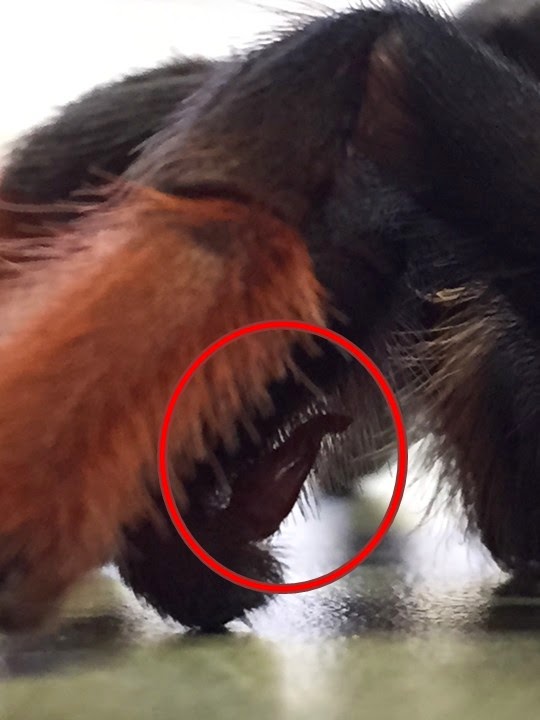
And then my geeky brain kicked in: this wasn't an injured spider, this was a male spider! Yup, Ginger was a male! The projections in the photo are called tibial spurs and are used to hold a female spider's fangs up while a male attempts to mate with her. After all, if he's not careful she'll make a meal out of him. And those shiny tips on the pedipalps?

The scientific term is an embolus (plural: emboli) but are more commonly referred to as "boxing gloves." However the boxing gloves in this case are not used for fighting other males as the name might suggest, but rather for impregnating a female by sticking one in an opening on her abdomen. Essentially you're looking at a spider's testicles right now, you dirty, dirty, reader you.

This new discovery led me on a classic Nature Geek quest for more knowledge. After conducting a thorough search on the proper terminology for the tibial spurs and emboli, I had to see them in action. Yup, I went searching for sex videos. I love that this is a legitimate part of my job, searching for sex videos and talking to my coworkers about how various living things have sex. In my search, I came across this video of the courtship ritual of the largest species of spider in the world, the Goliath bird-eating tarantula. Note how the male uses those tibial spurs on his legs to hold up the female. Also note how bapping your potential mate's head repeatedly is equivalent to sexy talk in tarantulas. (The courtship begins at the 2:00 mark)

So there you have it, Ginger is now a male (we think we are going to rename him "Rusty") and now whenever I use him for a program in front of a bunch of preschoolers I won't be able to not look at his junk. Yet another perk of my job.

Wednesday, April 30, 2014

Poison Ivy 101

A few years ago, Mr. Nature Geek wrote a post about the "Do-Nothing-Killer," poison ivy. With spring having finally sprung and baby poison ivy leaves beginning to grow, this week I thought I would share two videos about this vilified plant to help you avoid this plant's famous itch.

First off, an introduction to poison ivy. Why does poison ivy make us itch? How do you treat a poison ivy rash? Can someone truly be immune? Why should poison ivy be allowed to grow in natural areas? Find out! 

**Warning: this video contains graphic images of poison ivy rashes and blisters**

Now that you know a bit more about poison ivy, how can you avoid it? The best way is to learn how to identify it, which isn't always as easy as it seems. 

Poison ivy may be tricky in all its shapes, sizes in forms which can make it hard to avoid, but the plant is still worth keeping around for the benefits it provides wildlife. So this spring, be on the lookout with your new identification knowledge and stay rash-free!

Wednesday, April 2, 2014

The Courtship of Geekus naturus

In past blog entries, I've talked about all sorts of different animal mating rituals and systems. I've talked about how animals win each other over in one way or another, females kicking butt, and even some rather intimate details on animal sex. But today, I want to talk about the rather courtship of the species Geekus naturus.

Geekus naturus is a monogamous species, who sought out a potential mate that could demonstrate measurable geekery and humorous wit. In order to find this mate, she searched among a population of Geekus biologica. There, she came across this fine specimen:

This individual impressed the Geekus naturus with his geeky knowledge, humor, and of course other qualities such as ability to forage for food...
Here we see him collecting Rangia cuneata (wedge clams) to present to the Geekus naturus 
in order to win her affections and aid in her research in 2003.

perform impressive non-aggressive physical displays...

wrestle alligators...
(You tell that lizard he's not an alligator. We didn't want to hurt his feelings)

and demonstrate nurturing, fatherly qualities.

After a long courtship, this specimen, dubbed Geekus naturus v. mr. banded the Geekus naturus (v. the), solidifying their monogamous relationship.

On April 12, Geekus naturus v. mr. and Geekus naturus v. the shall proclaim their devotion to each other in front of a gathering of others of their species and live geekily ever after. 

See you after the honeymoon!

Wednesday, March 26, 2014

Joshua Tree National Park Revisited


Two years ago this week, Mr. Nature Geek and I visited Joshua Tree National Park. We had an amazing experience there, some of which I blogged about here. While we were there, I not only took lots of photos and videos for myself, but I also created a video for my Master's thesis on the birds of Joshua Tree and how they cope with life in the desert. And this week, I want to share that video with all of you! Enjoy!


Wednesday, March 19, 2014

Feathers: Form Fits Function

Last week, I wrote about how to improve the lives of your pets through enrichment. I showed examples with the animals where I work, but I never introduced you to my own pets! I have two pets, a male and female cockatiel.


This is Peanut, my little man:

And Tucker, my "lemon chicken" girl:

Right now, Tucker is in what I call a "super molt," something she goes through about twice a year. In the wild, birds replace their feathers twice a year: once in the spring, and again in the fall. This not only keeps them looking fresh and sexy for the ladies (or gents in the case of polyandrous birds), but also ensures that their feathers are in tip-top shape for flying. Birds in captivity, like wild birds, will lose and occasional feather here and there, but also go through periods where they molt large amounts of feathers at a time. During Tucker's super molts, she can sit preening (cleaning her feathers) for 30 seconds on the couch and this happens:
My house becomes littered with feathers, rolling across the floor like little tumblefluffs. But no matter how many super molts I've been through, I never get tired of seeing all the different shapes and forms Tucker's feathers come in. Birds' feathers are an amazing testament to form fits function, with each feather uniquely sculpted to fit a specific purpose.

Remiges
Peanut wanted to contribute to this post too, so his feather is showcased at the left. Remiges are the flight feathers on the wings; the classic quill feather. These feathers are stiff and strong and are inserted directly into bone instead of skin like most feathers, and so are able to push hard against the air in order to achieve flight. In actuality, all a bird's feathers have a role in flight, but if a bird loses too many remiges, it will be rendered flightless. The narrow side of the central shaft is the leading edge of the wing. Because of this, we can tell this feather came from Peanut's left wing. 


Retricies
Not as stiff as remiges, retricies are a bird's tail feathers and are also inserted straight into bone, in this case the last tailbone called the pygostyle. These feathers are responsible for steering in flight. A bird also steers with its wings, true, but holding its wings perfectly still, a bird can make a slightest twitch of its tail to turn. They can also spread their tail feathers to slow their flight, or tuck them in nice and neat when performing a swift dive. The feather on the left is one of Tucker's central tail feathers, as can be told by its perfect symmetry. Feathers from the left or right side of her tail look slightly different, like the beautifully patterned one on the right. Using the same guidelines as with the remiges, can you tell which side of the tail this feather came from?

Coverts
No covert operation here, just feathers whose job are to protect the flight feathers on the wings and tail. This feather is one of my favorite of Tucker's, a tail covert, aka "buttvert." Just look at the cup to fit her little feathered butt, people. And it's so fluffy I'M GONNA DIE. Nobody likes a cold rear end, and birds are no exception. All that fluff at the base of both the retrices and their coverts makes for a nice, warm, fluffy behind.


Contour Feathers
The majority of feathers you see on a bird are contour feathers, whose function is to not only keep the bird warm, but to give it its aerodynamic shape. The colors of the contour feathers also perform roles in attracting the opposite sex and camouflage. Most contour feathers have a slight curve, lending their shape to the overall curve of the bird. But look at the contour feather on the right. This feather is thin, perfectly flat, and almost rectangular. It's a wingpit feather! This feather is perfectly shaped to fit tightly up against Tucker's body beneath her wings. The last thing you'd want as a bird (besides a cold butt) is feathers that get in the way of your wingbeats. These feathers perfectly fit that need, protecting her body, while not getting in the way.

Other specialized feathers
There are all sorts of other little specialized feathers to be found on a bird's body, like tiny filoplumes...
which can be found at the base of almost every contour feather and are sensitive to air movement and vibrations. This allows a bird to feel the place of every feather on their body, and know when one is the slightest bit out of place and needs attention.

There's bristles:
which look like tiny whiskers between Tucker's eyes and beak but are special feathers stripped down to their central barb. Bristles like Tucker's help keep dirt, insects, and other foreign things out of her eyes and nostrils. Bristles on some birds, like nighthawks, help them to sense when insects are near their mouths when feeding. And on birds of prey and vultures, bristles mixed in with the contour feathers can help keep blood and gore off of the contour feathers.

And finally since we're talking about cockatiels, we have to mention the fabulous crest feathers:

For some feathers, their form is their function. That is to say that some feathers are fabulously shaped for the sake of being fabulous. For a cockatiel's crest, not only can they attract attention, but they are incredibly expressive, like little birdy eyebrows. You can even literally see Tucker thinking, as her crest goes up and down as she's really puzzling over how to steal food off of my plate. However, crest feathers are probably the most awkward thing to happen as they loosen during a super molt.
Poor, poor, unicorn Peanut.

Tucker's super molt is slowing down, meaning there are less feathers being dispersed all over my house. But whenever I pick one up, I can look at its shape and tell exactly where on Tucker's body the feather came from, thanks to nature's excellent design of form fitting function.