Thursday, March 29, 2012

Joshua Tree National Park: A Desert Far from Barren

I'm baaaaack! I've been sitting here for a while now, trying to decide what things to show you and to tell you about. I can't tell you about it all, because well, with over 600 photos and 120 videos (I love the digital age) I can't very well share it all. Well, I could but it would be a really long post and you'd have to call in sick from work tomorrow. That might not be such a bad idea after all...


How deserts got a reputation for being barren, lifeless places, I have no idea. Because from birds and cacti to reptiles and Joshua trees, there is life to be found all around you at Joshua Tree National Park. 


Amazingly, one of the most species-rich places Mr. Nature Geek and I visited was our own campground. Which, by the way, looked like this:
Jealous yet? 
The small green tent in the bottom left is ours. There was hardly anyone there because on our first night it was 40mph winds and snow. We toughed it out thanks to some very warm sleeping bags and were rewarded with perhaps the best camping experience either of us have ever had.

There were all sorts of birds around, along with Western fence lizards, black-tailed jackrabbits, and a California ground squirrel that was clearly up to no good. As a result, each morning I was constantly running around, camera and binoculars in hand.

Mr. Nature Geek: "Katie, what do you want to do today?"
Me: "Hang on, there's an Anna's hummingbird over there!"
Once I've returned...

Mr. Nature Geek: "Ok so what do you-"
Me: "The phainopepla is singing! I've gotta get that on film!"


I know what you're wondering: what the heck is a phainopepla? (and how do you pronounce that? The answer: "fain-o-pep-la") It's a bird in the silky flycatcher family that looks like a black cardinal. I spent all week chasing that bugger around taking photos and trying to get him on film as he sang. The fact that the National Geographic field guide states the phainopepla's song is "seldom heard" only motivated me more. And by the last day he bestowed upon me the honor of recording his song, while looking all handsome and such.


I also saw my first verdin:
He looks angry. Angry that we all can't be as cute as him!

Later in the week, we traveled to a true desert oasis. They really do exist!
In this lush green spot in the middle of a rocky valley, we spotted sage lizards, rufous hummingbirds, an American kestrel, and one very awesome desert spiny lizard. 
Mr. Nature Geek tried to pick him up, but his brush surroundings protected him from his grasp. Too bad too, because my field guide says that the desert spiny lizard "often bites when captured." I would have loved to have got that on camera.

Even outside of unique locations such as campgrounds and oases, there was diverse life everywhere, especially in the form of cacti:
A red barrel cactus
 Aren't those spines beautiful?
Beavertail cactus
(notice the flower buds...we arrived just weeks early for the big desert bloom...darn!)
Old man prickly pear
Cottontop cactus
 Ocotillo (though not a true cactus)
This one was in bloom though!
And last but most certainly not least, that last one is the jumping cholla. Those who have purchased cholla wood for parrot perches or hermit crabs will recognize the "skeleton" on the left. The jumping cholla is so named because it has detachable segments on the end of its branches that lodge themselves in passersby at the slightest brush. I am quite happy to say that neither I nor Mr. Nature Geek were impaled on our skin by any cacti, however our shoes received some cholla a few times that had to be removed with pliers.

Well I could go on and on about Joshua Tree National Park and its biodiversity, but this sample will have to do. If you have never had the chance to visit, I highly recommend you do. Oh and before I go, remember how I said I would not be hugging any Joshua trees?
I couldn't resist after all.

Friday, March 16, 2012

Do you hear that...

...that sound?  It's crickets chirping. And it's going to be just about the only thing going on this week and next on this blog. Why? Because The Nature Geek is going on vacation! w00t! I've been packing and working like mad this week, hence the absence of a blog yesterday. And next week, I'll be camping in Joshua Tree National Park in California, hence no blog then. 


But I promise I'll bring back souvenirs for all of you in the form of awesome pictures, ok? Maybe I'll even throw in some video clips too, if you promise to be good for the sitter.


And if you're wondering just what a Joshua tree is, they are these guys:
These trees just scream "No touchie!"

They should be in bloom too while I'm there. And if I'm in luck, more of the desert will be as well. A true desert ecosystem is one that I've been wanting to visit for a long time, and so I can't wait to get my geeky eyes and hands on some new flora and fauna. I don't think I'll be hugging those Joshua trees anytime soon though.

Oh, and one more thing before I go: if you're really good and want to help with my research project, you'll get the VIP chance to see a video blog on Joshua Tree National Park! *wink wink nudge nudge* Otherwise you'll have to wait a year until it's released to the general public.

So you guys be good, eat all your geeky vegetables, and I'll see you in two weeks! Bye for now!

Thursday, March 8, 2012

One Fish, Two Fish, Spear Fish, Spook Fish

Today I saw a great blue heron, flying majestically with neck tucked in a characteristic "S" curve and long legs trailing behind. It made me realize how much I miss seeing herons and egrets on a daily basis since moving from Florida to Pennsylvania. There are many reasons that I like herons and egrets so much, but I think one of my favorite things about them is that between great blue herons, cattle egrets, snowy egrets, and reddish egrets, each has a distinct style for catching their prey.


The "Stalk and Spear"

To watch a great blue heron hunt fish is to watch a very intensely focused bird that must have been trained by Yoda himself, which in this case is a green heron; also patient and intense, but green and secretive. Great blue herons will stare into the water with great patience, waiting for just the right moment.  And when a fish swims just a little too close...
Yeah, it's gotta suck to get digested alive.

This video was taken at a favorite spot for Mr. Nature Geek and I, the duck pond at the University of South Florida. We discovered that this great blue heron was not only Jedi-like in his hunting skills, but in mind as well. He learned that if he came down to the water's edge as people were feeding the ducks, that fish would also inevitably surface for the flung bread pieces. He had learned how to fish! Clever he is, yes, hmmm! (That was my Yoda impression. It doesn't come across as well through text.)

The "Dance Around like a Madman"
Clearly she's contemplating her next dance routine.

Reddish egrets are the opposite end of the spectrum when it comes to obtaining a meal, forgoing calm-like zen for dancing around with all they've got. The idea here is that by running round, the reddish egret scares small fish out of their hiding spots, making it easier for the dancing diva to get her lunch.


I was was fortunate enough to witness a young reddish egret (no more than a month or two old) practicing its dance on dry land. It ran back and forth, wings extended, until it danced up to a juvenile brown pelican, who looked less than impressed. It almost seemed like the young egret's happy balloon was burst, as it stopped dead in its tracks. Hey little guy, I enjoyed your routine!

The "Have a Big Friend" Approach
Are you gonna eat that?

The cattle egret has found friends in high places that help it find its next meal. In its native Asia, Africa, and Europe, the cattle egret evolved its feeding strategy into following large animals, who stir up insects and other small prey as they browse. Its relationship with large ungulates such as cattle is how the egret got its name. This hunting strategy is very similar to the reddish egret's, except with far less work required on the cattle egret's behalf.  These days, cattle egrets have learned to follow behind more modern "cattle":


The Shake a Leg / Fly and Drag
Sing it with me now!
"These toes are made for fishin', and that's just what they'll do. 
One of these days these toes are going to shuffle around in the water like fishing lures so that I can eat all of you!" 

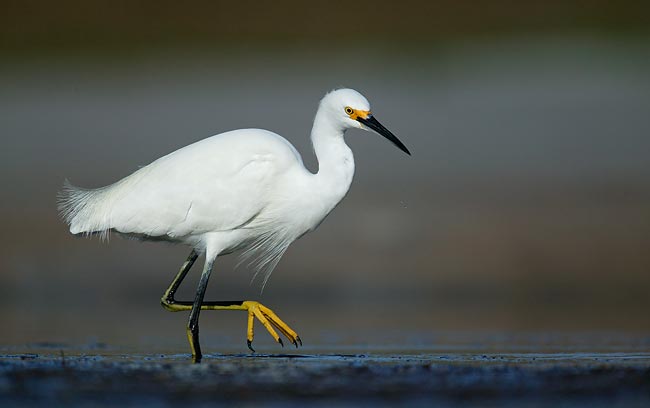
I think that last stanza was too long. But yup, that's what the snowy egret does alright; shuffle along in the water shaking its legs and toes, hoping that fish will be attracted to or scared by their bright yellow digits. In the meantime from a human's perspective, it looks like the bird is tentatively walking on ice after consuming about 6 Red Bulls.


Snowy egrets have a second technique to employ their yellow tootsies while hunting, the Fly and Drag. In this method, the egret flies across the water, dragging its toes. This lures fish to the surface, where the snowy egret plucks them from the water as it flies along.


Each of these birds have different foraging techniques, and not only do they work well for the bird, but they're a lot of fun for this human to watch as well. Many of these species are found across the United States, not just down in Florida, so keep your eyes open for these talented hunters!

Oh, and speaking of my Dr. Seuss tribute up in the title there, if you haven't had the chance to see "The Lorax" yet, I highly recommend it. It's Nature Geek approved!

Thursday, March 1, 2012

What's that Smell?

This week, I was driving home from work and found myself drooling over the smell of pizza as it entered my car. It made me think of how powerful smells can be--they can make us hungry or lose our appetite altogether, induce nostalgia, and form powerful associations.  Recently I asked my friends what businesses or locations they could identify by smell alone, and received answers like churches, libraries, grocery stores. Scents play an important role in the animal kingdom as well, and there are some quite impressive schnozes out there equipped to handle all of this sensory information.  Whether it's in the water, on land, or in the sky, the nose knows!

What aquatic animal has the best sense of smell? 
Did you say "sharks"? 

It has been said that a shark could smell a drop of blood in an Olympic-sized swimming pool. Well, whomever first said that would be wrong! First off, you'd have to put a gallon of blood in the pool, not a drop. Also, you'd have to mix it in with all the water in the pool in order for the shark to detect it; the shark couldn't smell it from one corner of the pool if it were concentrated in the opposite corner.  Don't get me wrong, that's still pretty impressive, but sharks ain't got nothin' on the channel catfish.


While sharks can smell at concentrations of one part per million, the channel catfish can detect concentrations at one part per billion. How do they do it? It's a matter of in one nostril and out the other. When water goes into one of the catfish's nostrils, it passes over little folds that detect scents before exiting though the other nostril; the more folds, the better the sense of smell.  Largemouth bass have up to 13 folds and rainbow trout have 18, but the channel catfish has more than 140! Going back to the pool analogy, all the channel catfish would need to smell blood would be one-fifth of a teaspoon mixed in with the whole pool.

This next creature hardly needs an introduction:

It's the star-nosed mole, and just look at that nose! Its nose has landed the star-nosed mole in the Guinness Book of World Records for the fastest forager, able to identify an object by touch within 25 milliseconds. How long is that? Well, in the time that it took you to blink just now, the star-nosed mole could have identified 12 different tasty treats. The mole's star has six-times more tactile receptors than a human hand. The nose is impressive for smelling as well--it can smell underwater! 

The star-nosed mole exhales tiny bubbles and then draws them back in, taking in scent molecules with them. I think if I tried that trick the only thing I'd find would be myself snorting, coughing, and spitting water all over the place.

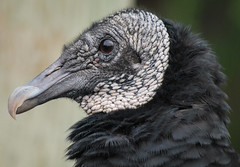
Lastly, I couldn't talk about smell in the animal kingdom without mentioning my beloved vultures. Black vultures don't have a good sense of smell. 
My buddy Smedley from Tampa's Lowry Park Zoo--sorry pal, but you ain't no catfish.

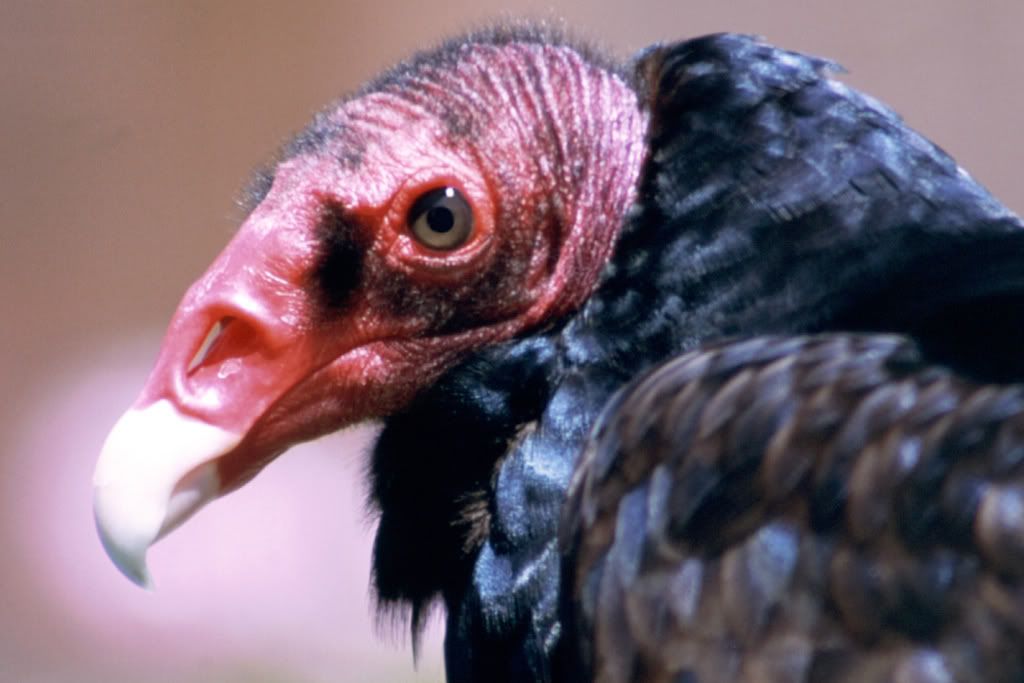
In fact, many birds have a poor sense of smell or none at all. That's why the great-horned owl is the number one predator of skunks...it has no sense of smell!  A bird that does have a good sense of smell? The turkey vulture. 

The air passing through its nares can lead it to a putrid paradise over a mile away. So why did I mention black vultures? It's because they don't have to rely on a sense of smell to find food, instead they can use their big brains and simply follow the turkey vultures! Now that's my kind of foraging.

Even though these animals all have great ways to detect scents in water, land, and air, I think having a poorer sense of smell might be a good thing. Smelling all the restaurants within a mile radius on my drive home would be too distracting!

Thursday, February 23, 2012

With their powers combined...they are SUPER GEEK!

Scary things happen when two like-minded geeks get together. Not only do they start "geeking out" together by gushing on about their shared passions, but they also teach each other things and add to each other's geeky knowledge.  Such an occurrence recently took place.

About two years ago, I met Karen Verderame of the Academy of Natural Sciences here in Philadelphia. I was getting a tour with a couple of coworkers and being introduced to some of the staff, when I saw Karen's office. It was full of bugs.  I can't remember my exact words, but I think they were something to the extent of "Look at those giant cockroaches! COOL!"  The geeky fire had been lit, and Karen and I spent the next 10 minutes or so talking about everything with an exoskeleton. Then, like a reluctant child, I was told by my coworker that we had to go.

Last night I was able to meet up again with Karen at a discussion about insects held at the nature center where I work. It was an hour and a half of geeky goodness--I had found someone as insanely passionate about her field as I am mine.  She shared stories of insect courtship, expensive insect shipments gone wrong (curse you FedEx!), and her love for her favorite insects: cockroaches.  I asked Karen if she loved the movie Wall-E for its cockroach star...
...and not only did she reply with an enthusiastic "yes!" but she also proceeded to identify Hal (yup, that's his name, I Googled it and everything) as an American cockroach and spouted off all sorts of facts about what will undoubtedly be the last survivor on Earth. And speaking of cockroaches and courtship, some male cockroaches will backup with their *ahem* "equipment" bared and just hope they run into a nearby female. No dinner first or anything!

Remember how I said that geeks learn things from each other?  The above cockroach love quest story is just one example of a geeky factoid I picked up from Karen. Last night I also discovered that I didn't know as much as I thought about scorpions!  At the discussion, Karen brought along a vinegaroon, which is one of the coolest looking scorpions ever.
No, that is not my hand. Or Karen's.

See those claws on the front? They as much define a scorpion as their distinctive tail (which tailless whip scorpions lack). Well those claws are also not legs, they're mouth parts!  Scorpions, like spiders, have modified mouth parts that help them acquire food. In spiders, they're called pedipalps and sometimes resemble small legs. In scorpions, they resemble claws and can function just like a crab's pincers!

The shortest "legs" in the front are actually mouth parts!

Oh and the name vinegaroon? It has to do with the scorpion's defense, which is not the venom that other scorpions use. Instead, the vinegaroon emits a small drop of acetic acid, also known as vinegar. Karen told us that often times she won't even know that a vinegaroon has used its defense on her until those around her start asking if anyone else smells vinegar. Hey Karen, with Easter coming up, I think you should tell them it's just the Easter bunny preparing to dye all those eggs and watch their response.  Maybe they'll learn something too!


Would you like to acquire some new geeky knowledge?  How about watching some videos...for science?

Saturday, February 18, 2012

Help The Nature Geek: Watch Videos for Science and Fun!

In December, I told all of you that I had a surprise in store for the new year.  It’s time to reveal just what I have up my sleeve!

I am conducting research on audience preferences in online interpretive video style and am looking for volunteers to participate in what could be ground-breaking research. Just what exactly does that mean, you ask?  Each month I will create two short (less than five minutes) video versions of my blog.  The two programs will be created using slightly different styles of program delivery.  I’ll then ask participants to watch both videos tell me which they preferred.

So what would be your part?  Each month for ten months, you would watch two short videos on The Nature Geek’s channel on YouTube. To share your opinion on the videos, you’d complete a 10 question survey (nine multiple choice and one fill-in-the-blank) and submit it to me via email.  And that’s it!  The amount of time you’d have to invest is about 30 minutes per month. Not only will you be making a significant contribution to the field of interpretation, but you will have the inside track on Nature Geek videos not advertised to the public.

If you are interested in helping me out with my study or would like some more information, email me at katie <at> thenaturegeek.com. I hope to hear from you soon!

Sincerely,

Katie Fisk
The Nature Geek

Friday, February 17, 2012

You Show Off! (part 2)

You can now take a deep breath everyone, Valentine's Day is over. Whether you got so sick of pink and red that it made you see red, or whether it's because you narrowly escaped forgetting the holiday altogether, you can relax knowing February 14 has come and gone.  Last week, I highlighted different techniques that both humans and animals share when it comes to impressing that certain someone.  This week, I would like to continue that list, touching on some techniques that either you witnessed others doing (and probably had a good laugh at) or dare I say, employed yourself.


Last week, I started off by talking about bird songs.  Birds and humans may be the first animals that come to mind when we think about singing, but plenty of other animals do it too: whales, canines, primates, and even alligators.  Male (and sometimes female) American alligators participate in bellowing, which is a deep vibration that resonates throughout their entire bodies and makes the water on their backs dance.  For you musicians out there, these bellowing bases belt out a B flat two octaves below middle C. Take that Barry White!


Hellooooooo, ladies!


If you are more of the type who would rather be seen than heard, you share the limelight with animals that participate in what I classify as non-aggressive displays (in other words, not fighting). 
We primp and preen, we put on the clothes that accentuate our best features (and hide our worst), arrange our hair just so, and literally strut our stuff. The animal kingdom has mastered this art as well. Fireflies flash their trademark lights, birds don spectacular plumage, and even the humble guppy comes in an array of colors, as always all to demonstrate superb genetic lineage.

And if that weren't enough, some animals as well humans up the ante by shaking their groove thing. Undoubtedly many of you have seen what has been called the "moonwalking bird", the red-capped manakin, who has the remarkable ability to channel Michael Jackson.
The manakin's dance begins at 2:00 (though the rest of the video is neat too)


Finally, there are those among us who have a "no holds barred" approach to courtship.  These individuals often provide the rest of us quite a bit of entertainment as they attempt insane daredevil feats. In the human world, it may often seem that those who fail get more attention than those who succeed! Course, these people probably aren't impressing too many ladies. One of the most impressive daredevil acts in the animal world can be found in...surprise surprise on The Nature Geek blog...birds. Some species of eagles do a fantastic display called cartwheeling, or whirling. This dance of sorts is used both between mates and rivals. Two birds will fly high into the air and then lock feet and spin towards the ground. In courtship, both birds let go. In a fight however, the cartwheel is like a game of chicken: the first bird to let go loses. 


Whether you participated in any of these or last week's methods of showing off or just watched in amusement, we humans are not alone in our methods of courtship. Just think, you now have an entire year to practice for next Valentine's Day!  Now if you'll excuse me, I have some Michael Jackson music to cue up.