Showing posts with label turkey vulture. Show all posts

Friday, June 12, 2015

Day in the Life: Bathing Beauty

At Briar Bush Nature Center, I care for a 2 year old male turkey vulture named Ralph. If you're a regular blog reader, (first of all, thank you) you may remember Ralph from a post I did last March on animal enrichment. Ralph still gets his enrichment in a variety of ways, and on this hot and humid day his enrichment didn't come in the form of food, but water. You think you get hot when it's 93 degrees and humid? Try being a dark brown bird with lots of insulating feathers! 

So today I got out the hose, set it to "gentle shower" (after all, no one likes a vulture with all its feathers blasted off) and sprayed it right on him. Most of the time when I try this, Ralph goes skittering to the nearest form of shelter. But today, I got this:
He was loving it! When he stretches his wings out, he's trying to get as much of his wings wet as possible. And that rowing action  you see him do with his wings is what he would do in a pool of water to throw it all over his body. Essentially you're seeing Ralph say "More! More! More!" with his body language.

Now that I got Ralph soaking wet, he did what vultures enjoy almost as much as roadkill; it was time to bask in the sun. The only problem is that there was no sunlight hitting his cage at the time. That's where I came in! I got him up onto my glove and took him out of his cage into the brightest, sunniest spot I could find.
Those wings immediately spread wide and Ralph got into the sunning zone. You know that look a dog gives you when you scratch their butt? That totally blissed out, half drooling look and they smack their lips just a little? That's the same reaction you get when you put a vulture in the sun. Ralph gets this far off look in his eyes and he smacks his beak just a little, like he's stopping himself from drooling. Vultures live for the sun. It not only feels good, but it kills bacteria on their feathers. Today it felt goooooood.

After a while, I decided to try something new for Ralph, letting him off my glove and onto the railing you see in the background of the above photo. I figured this would be more comfortable than sitting on my small and squishy arm and would give him more freedom to pivot his body for optimal sun absorption. I thought the railing would be a safe place to put him, where he was high enough off the ground that he wouldn't be tempted to try and jump down. I was right! He stepped onto the railing and basked in the sun, all the while taking in the sights of birds flying overhead.
If you have a dog or cat, you likely know its body language fairly well. You know that squinting eyes for a cat or a wagging tail for a dog mean that the animal is content and calm. Birds have body language too that you can read to know they are content and calm. One of those signs is called the rouse, in which a bird vigorously ruffles all their feathers. If a bird has been through something stressful and you see them rouse, you know they have calmed down and are ok. It's always a great sign to see when you work with a bird. After his sunning session, Ralph let out a great big rouse.
That is one giant puffball.

When my cockatiels rouse, often times it's very sudden. But with Ralph, he always works up to it, like a satisfying sneeze: he raises his back feathers ever so slowly...then the rest of his body puffs up...and then like he's rocking out to Taylor Swift, he throws his head back and shakes it off.

Today was a good day to be a vulture.

Monday, March 10, 2014

Keeping Captive Animals Wild through Enrichment

Those who know me personally are always hearing of my crazy, humorous, and sometimes disgusting exploits as the animal curator at Briar Bush Nature Center. And many tell me I should share these stories on this blog. Today, I thought I would give you a short behind-the-scenes look at just one aspect of what it means to care for a collection of captive animals, and how you can do the same at home for your pets.

The animals we have at Briar Bush are mostly surrendered pets, with a few non-releasable wildlife species, such as Henry the opossum, whom you met last month. No matter what the species of animal, from the wildest owl to the tamest rat, all captive animals need to exercise both their bodies and their brains, because a life in captivity is not as engaging as a life in the wild. In the wild animals spend their time looking for food, defending their territories, and engaging with others of their species. In captivity, food is always in the same bowl, the territory is established, and not all pets have someone around all day to interact with, human or otherwise. When we stimulate the brains of our beloved animals, it is called enrichment

What does enrichment look like? Many of you already have enrichment for your pets: that Kong for your dog, the catnip mouse for your cat, and even that plant in your fish tank all enrich their lives. The best forms of enrichment mimic some sort of behavior that is natural for that animal in the wild. Cats like to hunt, so we give them toys to pounce on. Parrots use their beaks to manipulate objects for food, so we give them complex toys. (For great enrichment ideas for parrots, check out Bird Geek Michele's blog http://foragingforparrots.com/Female rats like to make nests, so we give them cozy places to hide and things to shred.
Sisters Spot and Starr, enjoying their cozy hammock. 
They like to stuff it with shredded newspaper I provide to give it that extra homey touch.

At Briar Bush, a lot of the enrichment I provide centers around the natural behavior of foraging, or looking for food. Instead of just placing a plate or bowl in front of them, I trigger their natural instincts to find their own food. Enrichment for a leopard tortoise named Torti looks like this:
A pesticide-free lawn on which to dine! As an added bonus, Torti is receiving much-needed vitamin D and UVB from the natural sunlight as she grazes. And as an added bonus to the homeowner, she provides a mowing and fertilization service!

Enrichment for a turkey vulture named Ralph looks like this:
I call it RATBALL.

Ratball works off of a vulture's natural tendency to stick its head and beak inside of things in order to get food. What you may not know about vultures is that they are extremely intelligent. You've gotta keep uping your game to keep a vulture occupied! 
Ratball version 1.0 was just a mouse placed inside the ball. 
    Child's play (or rather chick's play). 
Version 2.0: a large rat that I had to really work to stuff inside the ball. 
    Apparently it wasn't work to remove it. 
Version 3.0: A rat burrito-wrapped inside a piece of bed sheet.
    Silly human, just pull the rat out of the end of the burrito.
Version 4.0 (seen above): Tie the rat inside of the sheet like a little drawstring purse inside the ball.
    Now we're getting somewhere! 

This one took Ralph a while to figure out, but eventually he used his powerful beak to just rip a hole right through the sheet to extract the rat, much like he would rip open a carcass in the wild. Today I am up to Ratball version 6.0, in which the bed sheet has been replaced with a much tougher washcloth.

And enrichment for a pair of red-eared sliders looks like this:
Yes, enrichment for the turtles meant death for the goldfish, but red-eared sliders don't eat turtle pellets in the wild, they eat living things. And whenever these two are fed live prey, they move faster and are more active than I ever see them at any other time. Suddenly their days go from boring and mundane to exciting and purposeful. That reptilian brain kicks in to hyper drive and they love every minute of it. Well maybe the male slider a little less, as he didn't catch a single one of the 8 fish. Pellets are more his speed.

Providing enrichment for the animals under my care at work and for your animals at home isn't just entertaining for us humans, but it's a matter of physical and mental health for our furry, scaly, feathery, slippery, and exoskeletony friends. And as you've seen with the case of Ralph the turkey vulture, providing enrichment can be a challenge for your brain as well! This week put your brain to the test to challenge your pets at home with some enrichment. Don't forget to share the video of your enrichment on my Facebook page...the internet loves cute animal videos.

Wednesday, January 15, 2014

Vomiting and Severed Limbs in the Workplace

Last month at my job, we got a new turkey vulture, an injured wild bird unable to fly. He was named "Ralph" because he was quick to employ the vulture defense of vomiting when threatened. It's a pretty good defense when you think about it; not only does the threatening animal (or Nature Geek) receive a smelly dose of partially digested dead animal delivered at their feet, but it also makes the vulture lighter, and able to take flight that much faster.

This kind of defense is completely normal among vultures. If one vulture saw another vomiting, it wouldn't think "eww, gross!" but instead "danger? where?" But what if we humans shared some of the same defenses as found in the rest of the animal kingdom? It got me to thinking of how the workplace might look quite differently.

Scenario 1: The Boss Confrontation
Boss: "Susan, I need you to step into my office right NOW."
Susan: 

Boss: "Ummm on second thought, why don't you just go back to your office. On third thought, you can stay in my office and I'll leave."

I imagine that even the most hardened of bosses would want to vent their office for a while after you vomited up your egg salad sandwich and coleslaw in their doorway.

Scenario 2: The Unwelcome Drop-In
<Joe, working diligently on a project at his desk, desperate to make that 3:00 deadline.>
Susan, appearing at door: "Hey Joe, do you mind if I--"
Joe:
Susan: O.O
          "AHHHHHHHHH!"
           *runs away with mad flailing of arms*

There's not too much that grosses me out in the natural world, but watching footage of a short-horned lizard squirt blood out of its eyes makes me wince every time. Probably because I just have a thing about my eyes, but I digress. (And now my eyes are watering just typing this. Great.) A few species of short-horned lizards, also nicknamed "horny toads," are able to change the pressure in their heads in order to rupture small blood vessels in the eyelids and can aim the resulting blood flow up 3-5 feet away. If that wasn't bad enough, the blood also contains a chemical compound that tastes bad to members of the canine family. This horror show defense mechanism is not effective against birds, however, who probably just think the horned lizard comes with its own flavor packets.

Scenario 3: The Unwanted Client Interaction
Susan: "Oh man Joe, here comes your client, Mr. Jenkins. That guy never stops talking!
Joe: 

Mr. Jenkins: "Joe? Susan have you seen Joe? I could have sworn he was just here a second ago."

The potoo has got to be one of the most spectacular examples of camouflage in the bird world. There are many birds with feathers colored to look like bark, but the potoo brings a stiff, angled body posture to its routine that sets it above the rest. Of course, when you look like this with your eyes open:
Coffee?
you are going to need to work harder than usual to disguise yourself in the tropical forests of Central and South America.

Scenario 4: The Staff Meeting
Susan: <thinking to self> Man, this meeting is so bor-ing. If I have to listen to the boss talk one more minute about bottom lines, I think I'm going to lose my sanity. I need a diversion.


Susan: "Run awayyyyyyy!"

Some species of lizards and salamanders have the ability to get out of a tricky spot by breaking off their tails, an ability called caudal autotomy, enabling them to escape the tight grip of a would-be predator. What's more, the severed tail segment can keep twitching for up to 20 minutes, keeping the predator distracted as the reptile or amphibian makes their escape. What about blood loss, you ask? These critters have it all under control! Muscles around the main artery to their tails pinch off at the moment of detachment, preventing any major loss of blood. 

Today with a bit of training, Ralph the turkey vulture doesn't live up to his name nearly as much. And although vomiting to get out of an uncomfortable situation may sound tempting on a bad day in the workplace, just keep in mind that vultures re-eat their vomit after the danger has passed. I don't think that egg salad sandwich is going to taste any better the second time around. 

Thursday, March 1, 2012

What's that Smell?

This week, I was driving home from work and found myself drooling over the smell of pizza as it entered my car. It made me think of how powerful smells can be--they can make us hungry or lose our appetite altogether, induce nostalgia, and form powerful associations.  Recently I asked my friends what businesses or locations they could identify by smell alone, and received answers like churches, libraries, grocery stores. Scents play an important role in the animal kingdom as well, and there are some quite impressive schnozes out there equipped to handle all of this sensory information.  Whether it's in the water, on land, or in the sky, the nose knows!

What aquatic animal has the best sense of smell? 
Did you say "sharks"? 

It has been said that a shark could smell a drop of blood in an Olympic-sized swimming pool. Well, whomever first said that would be wrong! First off, you'd have to put a gallon of blood in the pool, not a drop. Also, you'd have to mix it in with all the water in the pool in order for the shark to detect it; the shark couldn't smell it from one corner of the pool if it were concentrated in the opposite corner.  Don't get me wrong, that's still pretty impressive, but sharks ain't got nothin' on the channel catfish.


While sharks can smell at concentrations of one part per million, the channel catfish can detect concentrations at one part per billion. How do they do it? It's a matter of in one nostril and out the other. When water goes into one of the catfish's nostrils, it passes over little folds that detect scents before exiting though the other nostril; the more folds, the better the sense of smell.  Largemouth bass have up to 13 folds and rainbow trout have 18, but the channel catfish has more than 140! Going back to the pool analogy, all the channel catfish would need to smell blood would be one-fifth of a teaspoon mixed in with the whole pool.

This next creature hardly needs an introduction:

It's the star-nosed mole, and just look at that nose! Its nose has landed the star-nosed mole in the Guinness Book of World Records for the fastest forager, able to identify an object by touch within 25 milliseconds. How long is that? Well, in the time that it took you to blink just now, the star-nosed mole could have identified 12 different tasty treats. The mole's star has six-times more tactile receptors than a human hand. The nose is impressive for smelling as well--it can smell underwater! 

The star-nosed mole exhales tiny bubbles and then draws them back in, taking in scent molecules with them. I think if I tried that trick the only thing I'd find would be myself snorting, coughing, and spitting water all over the place.

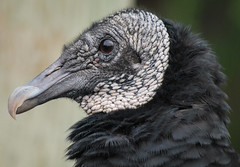
Lastly, I couldn't talk about smell in the animal kingdom without mentioning my beloved vultures. Black vultures don't have a good sense of smell. 
My buddy Smedley from Tampa's Lowry Park Zoo--sorry pal, but you ain't no catfish.

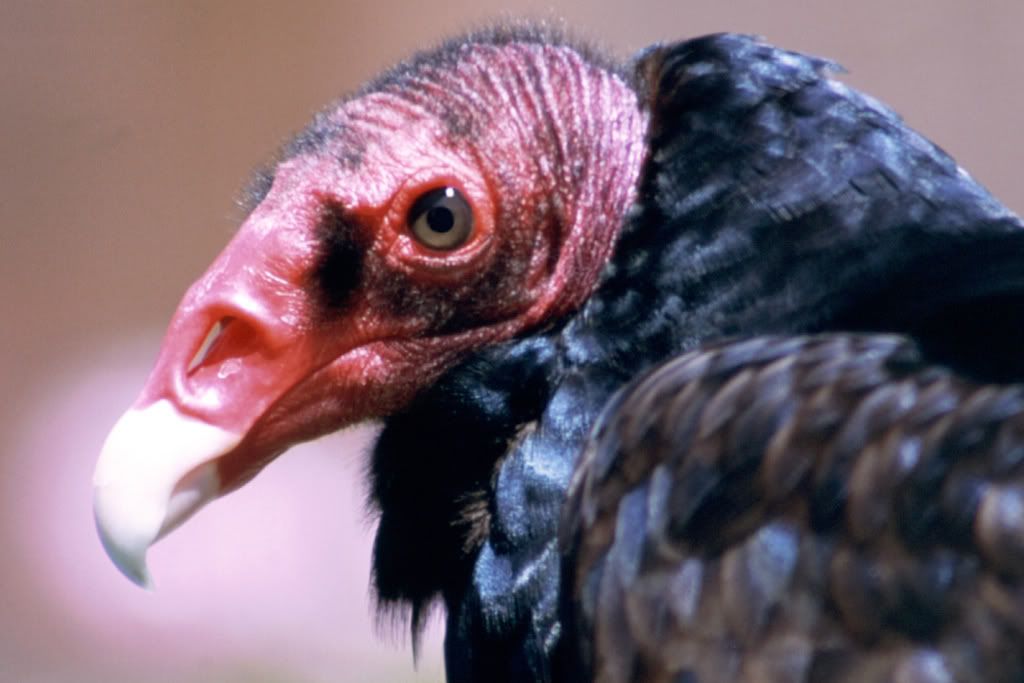
In fact, many birds have a poor sense of smell or none at all. That's why the great-horned owl is the number one predator of skunks...it has no sense of smell!  A bird that does have a good sense of smell? The turkey vulture. 

The air passing through its nares can lead it to a putrid paradise over a mile away. So why did I mention black vultures? It's because they don't have to rely on a sense of smell to find food, instead they can use their big brains and simply follow the turkey vultures! Now that's my kind of foraging.

Even though these animals all have great ways to detect scents in water, land, and air, I think having a poorer sense of smell might be a good thing. Smelling all the restaurants within a mile radius on my drive home would be too distracting!