Well, what do we have here? It appears to be some sort of...blog. Hey, someone should really update this thing, I mean geez, what kind of a person doesn't update their blog in 9 months? Oh wait. That would be me.
Right.
LET'S DO THIS THING.
Welcome to the new and improved Nature Geek blog! In addition to the various longer posts that I have traditionally written in the past, I will be featuring new posts called "A Day in the Life" in which I share exploits from my job as an Environmental Educator and Animal Curator at Briar Bush Nature Center in Abington, Pennsylvania. Many of you have commented that you'd like me to share more of these stories, and I am happy to oblige.
At Briar Bush, we have a Mexican red leg tarantula named Ginger, whom I acquired from her former owner when she was less than a year old. One of the first things I wanted to do when I got her was find out if she was a male or female, because not only do female tarantulas get larger, but they also live four times as long as males. Sexing a tarantula, especially a juvenile, is a difficult thing to do. One of the ways to do it is to examine a tiny little arrangement of hairs on the underside where the cephalothorax (what most would refer to as the "body") meets the abdomen (what many call the "butt" of a spider). If the hairs swirl in one shape, it's a male, if it swirls in another shape, a female. Now try doing this after you've grabbed a cranky tarantula around its waist and are holding it close to your face as it has its cranky fangs spread wide open. You get the idea. Fortunately, this tarantula molted, or shed its skin, within a couple weeks of acquiring it, so I was lucky enough to have a non-moving, non-bitey skin to use for sexing. I examined the hairs very carefully and was pretty sure I saw the hairs swirling this way and not that, so the tarantula was declared a female and named "Ginger."

Young Ginger as a 2" spider. Adult females reach up to 4" in body length, with a 6" legspan.
Over the past two years, Ginger grew and molted a total of 4 times, the most recent molt being two weeks ago. When tarantulas molt, it's a good idea to leave them alone for 7-10 days so that their soft exoskeleton can harden properly. On Wednesday I picked Ginger up and noticed that the tips of her pedipalps were shiny. The pedipalps are what look like short 9th and 10th legs on the front of a spider's body; you can see them in the photo above. Although a spider moves them as it walks, they are actually mouth parts and not legs, used for holding prey as the spider feeds. I was worried that somehow something had gone wrong and that perhaps the tips of Ginger's pedipalps had broken off during her last molt. I also noticed projections on her front legs where her red stripes were:

And then my geeky brain kicked in: this wasn't an injured spider, this was a male spider! Yup, Ginger was a male! The projections in the photo are called tibial spurs and are used to hold a female spider's fangs up while a male attempts to mate with her. After all, if he's not careful she'll make a meal out of him. And those shiny tips on the pedipalps?
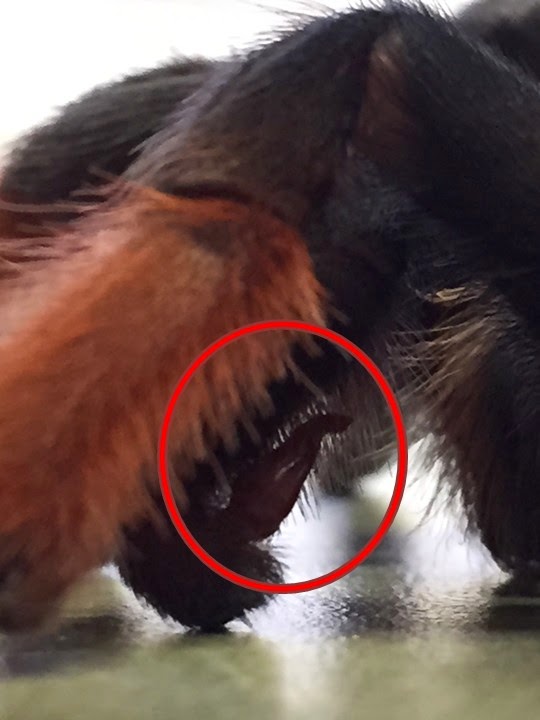
The scientific term is an embolus (plural: emboli) but are more commonly referred to as "boxing gloves." However the boxing gloves in this case are not used for fighting other males as the name might suggest, but rather for impregnating a female by sticking one in an opening on her abdomen. Essentially you're looking at a spider's testicles right now, you dirty, dirty, reader you.
This new discovery led me on a classic Nature Geek quest for more knowledge. After conducting a thorough search on the proper terminology for the tibial spurs and emboli, I had to see them in action. Yup, I went searching for sex videos. I love that this is a legitimate part of my job, searching for sex videos and talking to my coworkers about how various living things have sex. In my search, I came across this video of the courtship ritual of the largest species of spider in the world, the Goliath bird-eating tarantula. Note how the male uses those tibial spurs on his legs to hold up the female. Also note how bapping your potential mate's head repeatedly is equivalent to sexy talk in tarantulas. (The courtship begins at the 2:00 mark)
So there you have it, Ginger is now a male (we think we are going to rename him "Rusty") and now whenever I use him for a program in front of a bunch of preschoolers I won't be able to not look at his junk. Yet another perk of my job.