The idea that inspired this week's post is the classic case of the viceroy butterfly mimicking the colors of the poisonous monarch butterfly.
Take a look; first the monarch:

And now the viceroy:
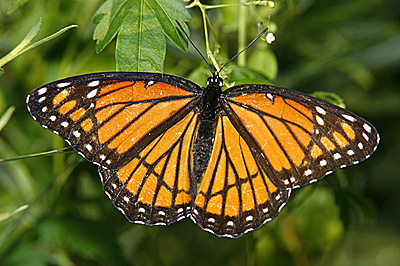
Quite the resemblance, isn't it? It feels like you're back watching Sesame Street to try to figure out how to tell the two apart. But you can...I'll just wait while you look them over.
*hums Jeopardy theme*
Did you find it? It's those bars on the viceroy's lower wings that give it away. And for a bonus round, if you ever see a butterfly with two black spots on the lower wings, like these:

What you're looking at is a male monarch butterfly! The monarch picture I used earlier is of a female. See? No spots on her, spots on him. Now scroll up and down repeatedly while thinking "Near...Far...Near...Far" in Grover's voice in your head.
Until recently, it was thought that the monarch-viceroy relationship was an example of batesian mimicry, in which a harmless species (in this case the viceroy) has evolved to mimic the appearance of a truly poisonous species (in this case the monarch). However new research has shown that the viceroy is indeed poisonous! This now makes it a case of mullerian mimicry, where two or more poisonous species have similar appearances through convergent evolution. In both batesian and mullerian mimicry, the desired outcome is the same: if a predator eats a black and orange butterfly which causes it gastric distress, as in the case of this blue jay...

Frame 1) "All right! A juicy butterfly for dinner!"
Frame 2) "Now that the wings are gone, down the hatch it goes."
Frame 3) "Dude, I don't feel so good..."
Frame 4) *Hyerk*
...it is going to learn to avoid all insects that are black and orange. Some insects advertise the same warning truthfully, and some "cheat" and copy off of other insects. Kinda like that kid who wouldn't stop looking at your paper during a test in 7th grade geography. Yeah, you know who you are....
A true case of batesian mimicry lies in the coral and milk snake relationship. The coral snake belongs to the cobra family (Elapidae) and has coloration like this:

I have had the privilege of seeing one of these in the wild while living in Florida. They are truly beautiful little snakes.
While its harmless lookalike, the milk snake, looks like this:
 Same colors, different pattern. As the saying goes, "red touches yellow, kill a fellow; red touches black, friend of Jack" or "red touches black, venom lack". The coral snake has yellow and red bands adjacent to each other, while in the milk snake (of which there are many species and slight hue variations), the red and black bands are adjacent.
In both the butterfly and snake examples, their mimicry is used to stand out to potential predators as their way of saying "Eat me and you'll regret it, pal!" But mimicry is also used to blend in, as a form of mind-blowing camouflage. And in my opinion, no where is this more spectacular than in the insect kingdom.

Giant leaf insect

The Indian leaf butterfly with its wings open...


A king swallowtail caterpillar looking as unappetizing as bird droppings

Cryptic stick-mimic caterpillar

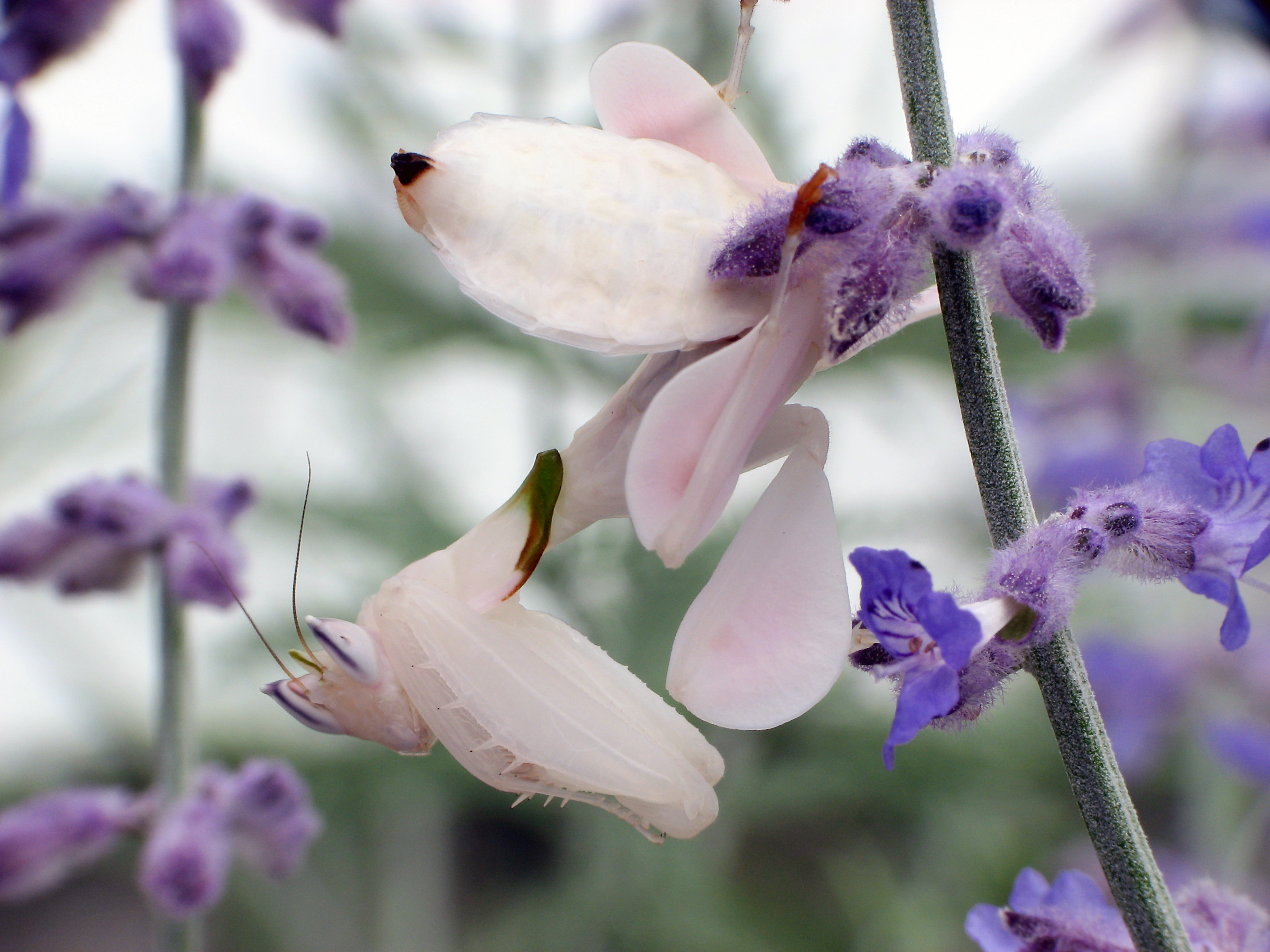
Orchid mantis
(Yes, there really is an insect there)
(Yes, there really is an insect there)
There are so many more examples, but it's really hard to top the orchid mantis. (And if you Google "orchid mantis" you'll see even more mind-blowing photos like the one above) There are even examples of plant mimicry as well, including an orchid that mimics insects! Whether it's being used to blend in like a super ninja or to outwardly advertise (or imply) danger, animal mimicry accomplishes an important function through some pretty amazing forms. But you don't have to take my word for it, take hers: