Wednesday, January 22, 2014

The White Stuff

Yesterday here in Philadelphia we got some snow. We got a lot of snow. We got enough snow to merit nonstop hyped up snow coverage on the news, two days of school cancellations, and a post apocalyptic scene in the local grocery stores. 
"It's beginning to snow and we're out of Pop Tarts?
STOCKPILE EVERY BOX."

Granted, it only takes about 2" of snow to cause this kind of mass hysteria in Philadelphia, but this time we received over a foot of the fluffy white utterly terrifying stuff.

I don't understand why snow causes such a panic around here, but that's probably because I grew up in North Dakota where they only cancel school for -65 degree wind chills and enough snow that you risk losing your toddler in. There are lots of animals that also laugh in the face of so-called "snow events" and today I thought I'd highlight some monochromatic critters and their ways of keeping their cool when faced with heaps of snow.

Polar Bears
Ah the pure white fur of the polar bear, as beautiful as the freshly fallen Arctic snow.

Except that a polar bear's fur is not actually white. Geek alert! A polar bear's fur is actually transparent in order to let the sun's heat go right through the dense fur and be absorbed by the bear's black skin, an incredible adaptation for keeping warm in a land of snow and ice.
A close up of polar bear skin and fur.

So why does it appear white? For the same reason that the snow outside my window forms a giant white drift instead of a clear one; the structure scatters visible light which causes it to appear white. Think of it as a kind of optical illusion. It works out pretty well...snow forts wouldn't be nearly as cool if everyone could see you inside of them. And let's face it, if a polar bear's fur was completely transparent and all you saw was the skin, Coca-Cola wouldn't have a very successful marketing campaign.
"Hey kids, wanna share a Coke and a nightmare?"
(This is not a polar bear, but rather a spectacled bear 
with a rather unfortunate skin infection)


White-tailed Ptarmigans
These small members of the grouse family are ready to strut their stuff no matter what season nature throws at them. For winter strutting, these birds have fluffy, feather duster feet to keep them warm. They even have feathers around their nostrils (nares) to pre-warm the air before it is breathed in. And of course, the bird's pure white plumage helps it to blend right in to its winter surroundings.
Sleeping in your own personal snow cave helps with camouflage too.
*pops head up* "Is that the pizza guy?"

But living in the alpine regions of Canada and down through the United States, it is not like the arctic home of the polar bear which stays white year 'round. So, like a little feathered fashionista, it changes its feathers to match the occasion.
Winter or spring, the white-tailed ptarmigan has just the thing!


Short-tailed Weasel (aka Stoat or Ermine)
This little weasel also goes through a wardrobe change in the winter and summer in the northern parts of its range. However the short-tailed weasel always keeps just a hint of black on the end of its tail to use as a decoy for predators. A hawk swooping in for the kill focuses on the easy to spot black tip of the weasel's tail, which is much harder to grasp in one's talons. Studies have found that this color strategy makes the short-tailed weasel harder for a hawk to catch than an animal that is entirely white, in which the bird's focus remains on the prey's entire body.  
"Can't catch meeeeee!"

Philadelphians may not be capable of dealing with a lot of snow, but the polar bear, white-tailed ptarmigan, and short-tailed weasel are built for life in the white stuff. Now if you'll excuse me, I have to start working on eating that stockpile of Pop Tarts.

Wednesday, January 15, 2014

Vomiting and Severed Limbs in the Workplace

Last month at my job, we got a new turkey vulture, an injured wild bird unable to fly. He was named "Ralph" because he was quick to employ the vulture defense of vomiting when threatened. It's a pretty good defense when you think about it; not only does the threatening animal (or Nature Geek) receive a smelly dose of partially digested dead animal delivered at their feet, but it also makes the vulture lighter, and able to take flight that much faster.

This kind of defense is completely normal among vultures. If one vulture saw another vomiting, it wouldn't think "eww, gross!" but instead "danger? where?" But what if we humans shared some of the same defenses as found in the rest of the animal kingdom? It got me to thinking of how the workplace might look quite differently.

Scenario 1: The Boss Confrontation
Boss: "Susan, I need you to step into my office right NOW."
Susan: 

Boss: "Ummm on second thought, why don't you just go back to your office. On third thought, you can stay in my office and I'll leave."

I imagine that even the most hardened of bosses would want to vent their office for a while after you vomited up your egg salad sandwich and coleslaw in their doorway.

Scenario 2: The Unwelcome Drop-In
<Joe, working diligently on a project at his desk, desperate to make that 3:00 deadline.>
Susan, appearing at door: "Hey Joe, do you mind if I--"
Joe:
Susan: O.O
          "AHHHHHHHHH!"
           *runs away with mad flailing of arms*

There's not too much that grosses me out in the natural world, but watching footage of a short-horned lizard squirt blood out of its eyes makes me wince every time. Probably because I just have a thing about my eyes, but I digress. (And now my eyes are watering just typing this. Great.) A few species of short-horned lizards, also nicknamed "horny toads," are able to change the pressure in their heads in order to rupture small blood vessels in the eyelids and can aim the resulting blood flow up 3-5 feet away. If that wasn't bad enough, the blood also contains a chemical compound that tastes bad to members of the canine family. This horror show defense mechanism is not effective against birds, however, who probably just think the horned lizard comes with its own flavor packets.

Scenario 3: The Unwanted Client Interaction
Susan: "Oh man Joe, here comes your client, Mr. Jenkins. That guy never stops talking!
Joe: 

Mr. Jenkins: "Joe? Susan have you seen Joe? I could have sworn he was just here a second ago."
The potoo has got to be one of the most spectacular examples of camouflage in the bird world. There are many birds with feathers colored to look like bark, but the potoo brings a stiff, angled body posture to its routine that sets it above the rest. Of course, when you look like this with your eyes open:
Coffee?
you are going to need to work harder than usual to disguise yourself in the tropical forests of Central and South America.

Scenario 4: The Staff Meeting
Susan: <thinking to self> Man, this meeting is so bor-ing. If I have to listen to the boss talk one more minute about bottom lines, I think I'm going to lose my sanity. I need a diversion.


Susan: "Run awayyyyyyy!"

Some species of lizards and salamanders have the ability to get out of a tricky spot by breaking off their tails, an ability called caudal autotomy, enabling them to escape the tight grip of a would-be predator. What's more, the severed tail segment can keep twitching for up to 20 minutes, keeping the predator distracted as the reptile or amphibian makes their escape. What about blood loss, you ask? These critters have it all under control! Muscles around the main artery to their tails pinch off at the moment of detachment, preventing any major loss of blood. 

Today with a bit of training, Ralph the turkey vulture doesn't live up to his name nearly as much. And although vomiting to get out of an uncomfortable situation may sound tempting on a bad day in the workplace, just keep in mind that vultures re-eat their vomit after the danger has passed. I don't think that egg salad sandwich is going to taste any better the second time around. 

Wednesday, January 8, 2014

Return of the Geek

I'm baaaaa-aaaaaack!


Man it feels good to be back! "What have you been doing for the past year and a half that you could not enrich my life with your witty, yet educational bloggings?" you ask? Let me explain. No, there is too much. Let me sum up:


You just watched the outtakes from a series of short videos I created as part of a study for my graduate degree in Environmental Education and Interpretation. Videos that I can now share with all of you!

The middle of winter may not strike all of us as a perfect time for a nature hike, but now is an ideal time to get out and look for animal signs. And if you are fortunate enough to live in an area with snow on the ground right now, the signs are even more abundant! What kinds of stories might be revealed? Find out by watching this week's video!


Be sure to follow my trail right back here next Wednesday. See you then!

Wednesday, June 13, 2012

Nature Geek SMASH!

(Nature Geek disclaimer: I have no idea what's going on with the formatting in Blogger tonight, guys. So I apologize for large gaps between text blocks and pictures. Please forgive my messy appearance, as they say!)

Today I purchased a bathroom scale and after I removed it from the box, saw the familiar plastic "Pull" tab that allows the battery to make its connection and the device to turn on. I pulled the tab and instead of the tab coming out, it remained in place and the entire battery pack came out of the scale, breaking the wire connections in the process. In that moment I felt like I had unleashed some freakish strength, that I should dye my shorts purple, and yell "Nature Geek SMASH!" Turns out I'm not really that strong, it was just that the wires and soldering were that weak and the design of the thing that poor.

Still, it got me to thinking; who are the true hulks of the animal kingdom? 

Strongest Lifter (Tractor Pull Division): 
Oribatid Mite 


Bet I surprised you there, didn't I? When it comes to this division, we usually think of ants and rhinocerous beetles as being the ones to pull their weight around. While it's true that the leafcutter ant can lift 20 times its weight, and the rhinocerous beetle 850, even the runner up in this category, the Onthophagus taurus dung beetle, which can pull an immense 1140 times its own weight, can't compare to this tiny mite. This species of soil-dwelling oribatid mite which has a mass 1/30 that of a snowflake, can pull an item that is 1170 times heavier than itself. This would be the same as you dragging a full grown northern right whale behind you (on land) using the world's largest dogleash.


"Mommy, can I keep him?"

Strongest Lifter (Flight Division):
African Crowned Eagle


Flying with an object 4 times your own weight may not sound impressive next to the feats of the oribatid mite, but it's a lot harder to fly with an object than to simply drag it across the ground. The hardest part is just getting into the air. The African crowned eagle is able to take flight with prey as large as monkeys and small antelope. To put that into perspective, imagine one of these...

taking off with attached to its wheels one of these...
which inside are four of these.

(Er, the big one, not the small one)

Impressed yet? Yeah, me too.


Strongest Bite:
American Alligator


The current record for the strongest bite of an American alligator comes from a 13.5 foot wild gator known as "Hercules". Scientists measured his bite at 2,960 pounds of force. The strongest mammal bite, by comparison, belongs to the hyena and measures only as 1,000 pounds of force. Let's look at it another way, shall we? If Hercules bit onto your leg, it would be the same as dropping a stack of three of these...


onto your cherished appendage all at once. Ouch.


Strongest Punch:
Kool-Aid Man


Sorry beloved childhood icon, it's really this guy:

Mantis Shrimp


Don't let that pretty face fool you, this guy can deliver a punch with acceleration equal to that of a .22 caliber bullet. How the mantis shrimp does it is absolutely baffling, and involves a blunt force object (his club-like appendages), some of the fastest muscle movements known in the animal kingdom, and the instant creation of boiling water. As usual, the BBC does a great job of explaining it in this video.

The mantis shrimp's punch is so strong, that in captivity it has been known to break the glass of its aquarium. Perhaps this guy isn't so different from the Kool-Aid man after all!


Ok, so maybe I didn't posses super human strength when trying to remove that darned "Pull" tab earlier today. That's not so bad though, I don't like the idea of having to buy a new wardrobe every time I get angry. But the oribatid mite, African crowned eagle, American alligator, and mantis shrimp are the true hulks of the animal kingdom, and they accomplish their feats without the use of gamma rays.

Wednesday, May 30, 2012

Indoor Cats: It's Only Natural

When I was growing up, I had a cat named...I'm not making this up...Kinky. This is what happens when you let children name a cat. He had kinks in his tail, hence: Kinky. I grew up a cat lover and had Kinky by my side for 14 years. 
Me and my big sister, Jenny, with Kinky in the window (before he put on a few pounds). 
What my sister was up to in this picture, I have no idea, 
but it probably involved corrupting my sweet, innocent, 2-year old mind.

On occasion, we'd let Kinky roam outside, but always accompanied. We were too worried that he'd meet his end either via vehicle or neighborhood dog. I always joked that Kinky posed no threat to wildlife as birds spent more time terrorizing him than he did them. That and the fact that my cat weighed 20 pounds would probably have made him a pretty poor hunter.  


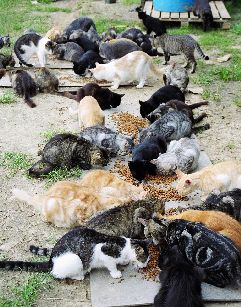
The truth is that cats are in fact superb hunters, relying on thousands of years of instinct to catch their prey. They are some of nature's finest predators, and this includes our own pets. There are three kinds of domestic cats you will encounter outside: "outdoor cats", strays, and feral. "Outdoor cats" are those that are allowed to freely roam outside by their owners, whereas strays are ones that have either run away from their homes or have been abandoned by their owners. Feral cats are those that have never been a pet; they were born in the wild. The issue of outdoor cats is a long-contested and hot button topic. Today, I thought I'd answer what are some of the most common questions and comments that I hear about cats.

Cats are a part of nature, and they have to eat too. Why is it bad that they eat wild animals?
The answer here is that domestic cats (Felis domesticus) are not a part of nature. They have been bred for thousands of years to be a companion to man, to dwell along side of us within our households. A cat is no more a part of nature than a domestic chicken, dog, or hamster.

This is why outdoor cats are such a sensitive topic among biologists--they are not a native and wild species but are having a profound impact on true wild native species. They not only cause a decrease in bird populations (cats are the number one cause of mortality for birds), but threatened and endangered species of other animal groups as well, including sea turtle hatchlings.


I think this is the expression Kinky would have
 had if we made him wear a collar like this.
What if I put a bell on my cat's collar?
Cats are very, very, good hunters, and can learn to sneak along without causing a single bell chime. And because cats with bells on their collars learn to adapt their hunting style, it actually makes them even better and more efficient predators.


"I swear I wasn't going to put this
at the foot of your bed."

If I feed the stray/feral cats, they won't need to hunt. 
This is one of the most common misconceptions about stray and feral cats, and unfortunately it is not true. Even a well fed cat still has its predatory instincts intact and will still hunt. A great example of this is cat owners who find little "gifts" in their house such as birds and lizards. The cats are well cared for and fed, but still catch and kill wildlife.

In addition, feeding stray and feral cats only causes their populations to increase. When an animal has ample resources for survival, its body's response is to breed. By providing more than enough food that the cats need to survive, they breed frequently and populations skyrocket. A female cat can start to breed as early as five months of age, and can have two to three litters a year. I may not have my calculator handy, but I can tell you that is a lot of cats! (But if you really want to see the math, look here)

Cats only pose a risk to the animals that they hunt.
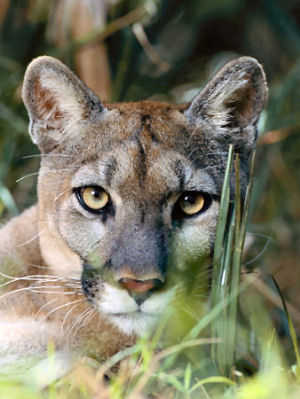
Feral cats have introduced Feline Panleucopaenia (FPL), closely related to the lethal canine parvo, into not just other domestic cats, but wild cat species as well such as bobcats and panthers. Untreated, FPL has a 90% mortality rate. In Florida, the endangered Florida panther population has contracted FPL, further contributing to their decline. 


So what can I do?
If you do see a stray or feral cat in your neighborhood, please do not feed it. Contact a local shelter or cat rescue; they may be able to help you find a home for your feline friend. If you have an outdoor cat, it is possible to convert it to be an indoor cat--be patient and stick with it...you can do it! There are many resources online for helping your cat (and yourself) make the transition from the urban to the indoor jungle while making sure your cat is still enriched mentally. Indoor cats live longer, healthier lives and in turn your backyard wildlife will live longer and healthier lives too! 


Thursday, May 24, 2012

What's the Big Deal? The Japanese Spider Crab

It's time for some behind-the-scenes Nature Geek info. Every week when I publish a new post, I geekily sit here and watch the metrics on my blog. It's kind of like stalking...from the other side. I watch to see how long it takes for the first person to read the post, and how many people read my post within an evening (the answer: literally tens of you). I can also look at the all-time history of my blog to see which posts are the most popular. 

I moved my blog from Facebook to Blogspot in October of 2011 and since then my top posts have received about 150 to 400 views. However, even my #2 most popular post of 420 views, "Test Your Turkey Trivia!" is a drop in the bucket compared to my most popular entry, "It's Always Halloween in the Natural World." How many views has it received? 17,172! And the reason? People Googling for this picture of the Japanese spider crab.
This is one popular crab.

So just what is the fascination with Japanese spider crabs? I decided to find out.


Let's start with the obvious: its size. Japanese spider crabs are the largest and longest lived of all crabs, with a lifespan of up to 100 years and a legspan of up to 13 feet (4 m). Just imagine a crab able to straddle your bed and peer down at you with its beady eyes. 


Are you sleeeeepy?

However when you look at the body alone, it's really not that large. Sure, it can be about the size of a basketball and weigh up to 44 pounds (20 kg), but when you consider the heaviest American lobster ever recorded was of equal weight and its total body length was only around 2 feet (0.6 m), the Japanese spider crab is really a lightweight. 

Typical of crabs, the Japanese spider crab is a scavenger. They roam the ocean floor, down to a depth of up to 2500 feet (800 m), feeding on animal carcasses they come across. Stories have been told of spider crabs feeding themselves with the bodies of those who have died at sea, which in reality is quite plausible. But with their reported gentle nature and relatively small front claws, a Japanese spider crab isn't exactly going to pull you out of your boat (plus again the crab is a scavenger, not a predator). If there was a crab that I would be afraid of coming after me, it would be this guy, the coconut crab.
This man looks like he's about to get a nipplectomy from that coconut crab.

If the Japanese spider crab were to enter a Miss Benthic contest, it would surely win. I mean not only would it clearly have the best legs in the competition, but it has a pretty good platform as well. With those long legs, Japanese spider crab tendons are often used in research. There is even research being conducted right now on using the crab's tendons for nerve regeneration. That would most definitely beat out the platform of the hagfish, which is "copious slime production for all." 
The next Miss Benthic? I think not.

So there you have it, Japanese spider crab lovers, some information on your favorite crustacean. Thanks for stopping by my page and while you're here, post a comment on just what teacher out there is obsessed with research papers on spider crabs; I'd really like to thank him or her for driving traffic to my blog.

Wednesday, May 9, 2012

Too Dark, Too Light, or Just Right?


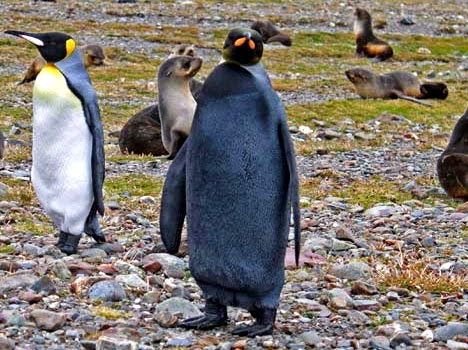
As I turned on the tv this evening, I saw a Nature episode on PBS chronicling the lives of two white white lion cubs in Africa. Individuals such as these indeed lead a difficult life; their inability to produce dark pigments leaves them not only highly visible to predators, but often not very attractive to potential mates. It's a rough life being different, something I think we can all identify with. However albinism isn't the only condition that can affect an animal's appearance. There are several ways an animal's coloration can vary, from not enough pigment, to too much, to poor diet.

Leucism
Leucism, as seen in the lion above, is very similar to albinism, causing animals to be white or at least lighter in coloration. This is due to a lack of melanin, the pigment mostly (more on that later) responsible for an animal's color. The difference between albinism and leucism is that in albinism, the body cannot produce melanin and in leucism, melanin can be produced, but just isn't deposited normally on the skin, fur, feathers, scales, etc. Sometimes leucism just occurs in patches, resulting in what is referred to as a pied or piebald color morph.
Hey, who forgot to finish painting this snake? Nah, it's just a piebald ball python.


To tell an albino from a leucistic animal as in these American alligators, just look at the color of the eyes. Albinos have red eyes due to the lack of pigment--the red you see is due to the blood vessels in the eyes. Animals that are leucistic will still have colored eyes, but will be lighter than usual; commonly blue. 

Melanism
Melanism is the opposite of albinism and leucism, meaning an animal has an over production of melanin, resulting in a color that is much darker than usual. Whereas animals that are lighter than usual often have a much lower survival rate because they stick out like a sore thumb in their environment, animals that are darker than usual may be at an advantage. One classic case of this is known as "industrial melanism", as seen in the peppered moth. 

Before the industrial revolution, peppered moths looked like this:
Yes, I promise there are two moths in this picture.

Their light coloration made for a spot-on match to lichen covered tree bark. Those moths that were too dark, ie melanistic, were quickly picked off by predators. However, once the industrial revolution began, pollution entered the air, killing off the sensitive lichens. This resulted in a role reversal: the light moths were now picked off the bare tree bark and the dark moths proliferated.
Dark moth: Yeah, who's laughing now?

Melanism became an adaptation, an advantage, in this situation. Other situations similar to these also occur, independent of human causes, for example a melanistic nocturnal animal better suited to hide in the dark night.

Carotenoids
Remember how I said that melanin is the pigment mostly responsible for an animal's coloration? Well if you don't, I'm beginning to question just how closely you really read my blog. There are other pigments responsible for color, such as carotenoids. Carotenoids are produced in plants and are responsible for reds, oranges, and yellows in animals, mostly in birds and crustaceans. The only problem is that animals cannot produce their own carotenoids, so they must get it through their diet. The classic example that most people have heard about is the flamingo, which derive their pink from algae and invertebrates that they consume.

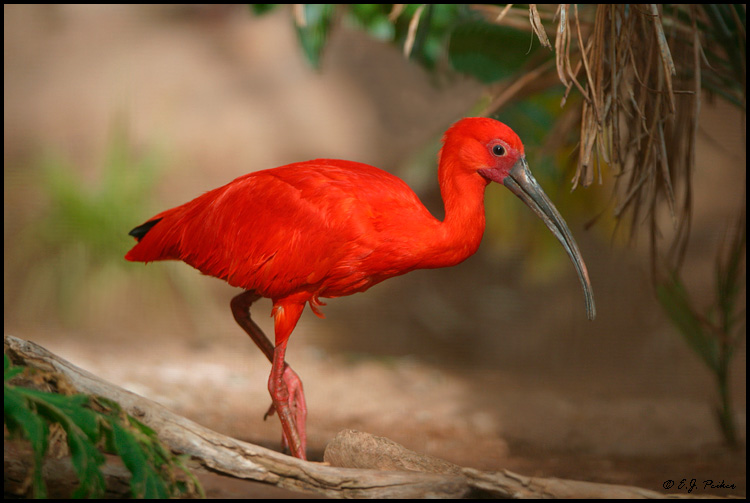
This good little ibis has been
eating all of his pellets.
Flamingos and other birds, such as the scarlet ibis, do not have the same foods available to them in captivity as they would in the wild. So how come they are still a vibrant pink? Dietary supplements! At the zoo I used to work at, we could always tell which scarlet ibises were good little birdies and ate their ibis food, and which preferred to steal from the diets of other species: the offenders were always a lighter shade of pink.


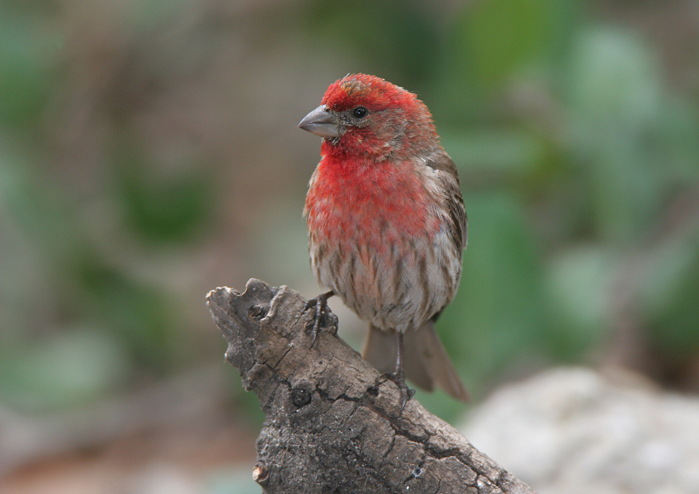
Many of our more familiar backyard birds rely on carotenoids for their brilliant colors: northern cardinals, goldfinches, and house finches, for example. 
The house finch is a common visitor to backyard feeders.

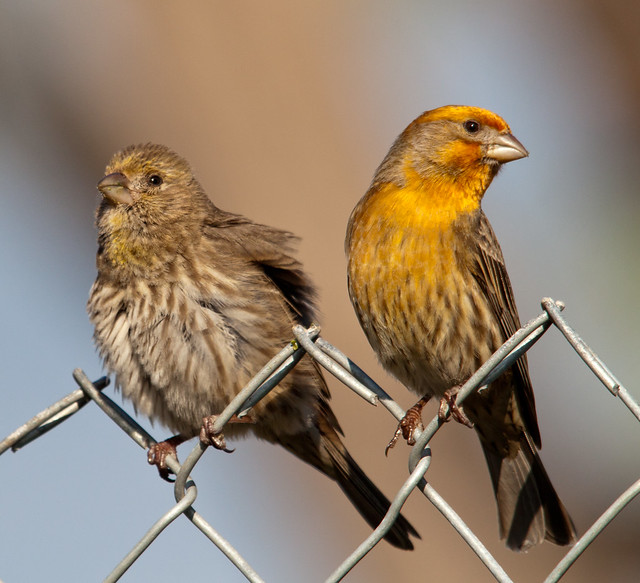
For house finches living in Hawaii, their diet has come to be quite different than their relatives living on the mainland, and as a result, their feathers look like this:
Aloha! Oh look, it's the NAI International Conference!


Source: allaboutbirds.org
Whether it's albinism, leucism, melanism, or carotenoids, there are many ways in which an animal's appearance may vary. Some may be a disadvantage, while others may provide an advantage. Another fun factoid for you: black feathers are actually stronger than feathers of other colors! This is why if you look at birds that spend a lot of time soaring, such as gulls, white-pelicans, and white ibises, you'll see many of them have wings with black tips. Regardless of the reason for their colors, as humans we are always fascinated with any deviations that we see in an animal's color--an instance when being different is truly celebrated.