Thursday, January 19, 2012

Well, that stinks.

Today was a stinky day.  Not that I had a hard day at work, mind you, rather I encountered two animals today that can be rather smelly. I found a green stink bug hiding in some leaves, and was relieved that he was too cold to live up to his name. I did however smell a red fox, whose odor is very similar to a skunk.  So given these smelly signs, this week I wanted to highlight two of nature's smelliest plants and animals, both of which can clear a room faster than my friend Paul can download the Phillies font to use illegally on his sports blog (watch out Paul, SOPA is coming for you).  The striped skunk and corpse flower may both stink, but their reasons for doing so are complete opposites.


The Striped Skunk
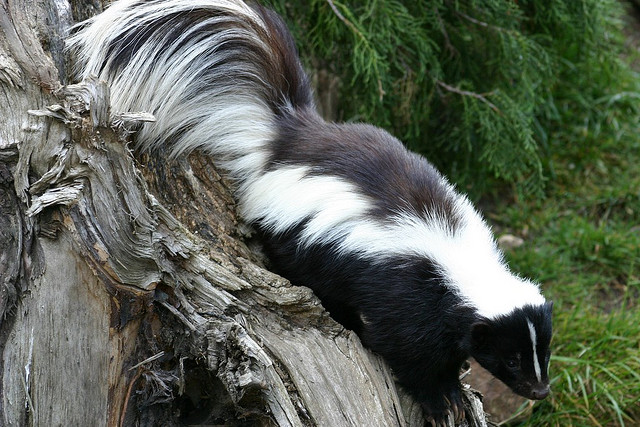
Which is more potent: a skunk's smell, or...

its cuteness?

Ah yes, the beloved striped skunk.  There are six species of skunk in North America, all of which can produce a strong smelling liquid, or musk, to scare off predators and annoyances, such as my neighbor's dog.  The distinctive musk comes from two glands on either side of the skunk's anus (yes kids, The Nature Geek just said anus!) and in the striped skunk at least, contains sulfur, among other delightful odors.  As if the smell isn't bad enough, the skunk can hit its target up to 12 feet away, and with a pretty impressive degree of accuracy.  If the skunk is really lucky, the musk will get in its pursuer's eyes and cause temporary blindness.


By the way, how do you remove the remains of this offensive odoriferous onslaught?  Tomato juice?  Scientists say nope. Apparently the only reason we think tomato juice works is because our noses have been so overwhelmed by the skunk's musk, that they stop smelling it altogether, a phenomenon known as olfactory fatigue.  You may not smell the skunk on your dog after giving it a tomato bath, but anyone visiting your house would smell it right away. "Ok smarty pants scientists, so what does work?" Apparently it's all about giving the musk some extra oxygen, thusly:


•  Bathe the animal in a mixture of 1 quart of 3% hydrogen peroxide (from drug store), 1/4 cup of baking soda (sodium bicarbonate), and a teaspoon of liquid detergent. 
•  After 5 minutes rinse the animal with water. 
•  Repeat if necessary. 
•  The mixture must be used after mixing and will not work if it is stored for any length of time. Since it releases oxygen, it cannot be stored in a closed container. For inanimate objects one cup of sodium hypochlorite solutions (liquid laundry bleach) in a gallon of water is cheap and effective. 


The Corpse Flower
Sir David Attenborough next to a corpse flower.  
I would like to take this time to state that David Attenborough is one of the coolest people. Ever.

With a name like "corpse flower", you've got to wonder why more people don't use them in weddings.  It might be because a six foot flower pinned to your lapel is hard to walk with.  The corpse flower is indeed the largest flower in the world, with the record for the largest individual being nine feet tall.  It might also have to do with the fact that the corpse flower smells like rotting flesh in order to attract pollinators. Flies and beetles, detecting the smell of a rotting animal, will fly to the source in hopes of depositing their eggs.


What is especially amazing about the corpse flower is how it spreads its eau de cadaver. Growing in dense Sumatran forests, the corpse flower ensures that its siren scent travels far and wide by growing a large delivery device (the flower) that produces smelly steam which rises in the jungle night.  In one study, a corpse flower that was air temperature (68 degrees F) reached an astounding 90 degrees and held that temperature for over four hours.  Apparently if you find yourself suffering from hypothermia in a Sumatran forest, just go snuggle up with a giant flower that smells like a dead thing (Of course that's assuming you can find one; they only bloom every one to three years).


The striped skunk may be trying repel animals and the corpse flower attract them, but let's face it, both strategies stink.


Thursday, January 12, 2012

A Bite with a Punch: the Short-tailed Shrew

Do you know what lies beneath your feet?  Well for me right now that would be the coffee table, but that's beside the point.  What I'm referring to is an animal that is a venomous terror. An animal with an insatiable appetite.  An animal...that is four inches long and furry. It's the killer short-tailed shrew.

Don't be fooled by that adorable face!

You read that right, a venomous mammal!  The short-tailed shrew is one of only a few venomous animals in the world, joining the club with the platypus of Australia.  


Our shrew has such a high metabolism that it must consume the equivalent of its body weight each day and can starve to death in just a matter of hours. As you can imagine, this can be pretty problematic if you can't find food in the frigid winter soil.  But this is where the venom comes in.  When a short-tailed shrew finds a large supply of food, it's favorite being insects and earthworms, it will go around and bite each one.  Its venomous saliva then works like that of a cobra's and paralyzes its victims without killing them.  The shrew can then carry its prize back to its nest and have a store of food available at all times.  Insects that have been paralyzed by short-tailed shrews have been known to remain alive for another 3 to 5 days. This strategy works so well for the minute mammal that it actually increases its weight in the winter!


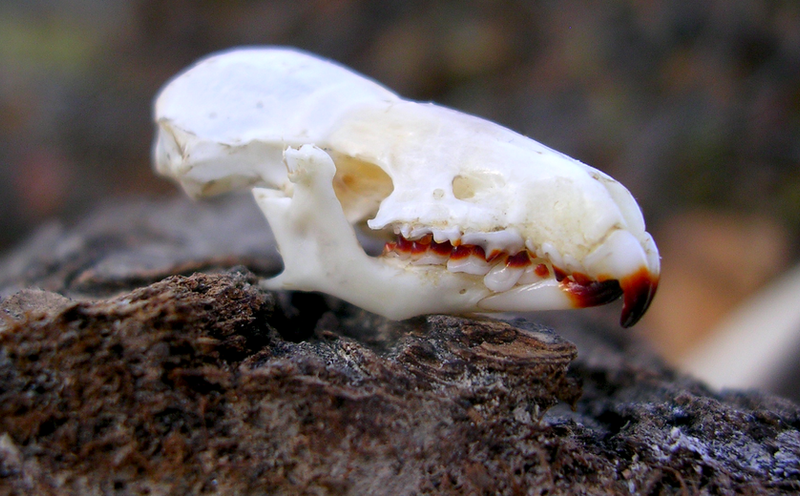
It seems that mother nature wanted to do everything it could to make the short-tailed shrew as badly cool as possible.  Not only is it venomous, but the teeth with which it delivers its venom have red tips that make them appear to be dripping with blood.


This dental trait is shared with close relatives, whom are all appropriately referred to as "red-toothed shrews".  They may all have red-tipped teeth, but not all of them are venomous!


Now before I go, I should calm your now frazzled nerves by telling you that the venom of the short-tailed shrew is of no danger to humans.  Those whom have been bitten have described the effect to be similar to a bee sting.  I did however find an interview with a well-respected shrew biologist that described a more memorable bite: "he remembers one student who was bitten on the hand by a particularly angry shrew that had to be pried loose. The student's arm became swollen and painful and showed signs of internal bruising that lasted more than a week (Source found here)." The moral of the story?  

Don't mess with the short-tailed shrew.

Thursday, January 5, 2012

Not So Ordinary Birds

It's very common for us to take for granted that which we see every day.  Having lived in North Dakota and Colorado, Canada geese were a very common sight.  It wasn't until I lived in Florida for eight years, where I didn't see a single goose, and then moved back up north to Pennsylvania that I realized how much I missed seeing them.

Many birds that we see every day are more intelligent than one might give them credit for. Vultures, rock doves (pigeons), and European starlings all score high on their avian ACTs.  In fact, one of the most clever of bird families can be found in your own backyard.  Corvidae is the family of birds that includes crows, ravens, and jays, all of which are bird brainiacs. Recently I have had the privilege to get to know a fish crow on a personal basis thanks to my friends at the Schuylkill Center Wildlife Rehabilitation Clinic, here in Philadelphia. 

Crow with his best friend, Michele, of the Schuylkill Center Wildlife Rehabilitation Clinic

The fish crow, known just as "Crow", was brought to the center after reportedly landing on people's heads and shoulders without any fear.  Still young enough to have blue eyes and the remnants of a fleshy gape at the corners of his beak, Crow was so imprinted on humans and disinterested in his own species that he was deemed non-releasable.  I got to meet Crow in his large outside pen just a week after his arrival at the center and was charmed by watching that big ol' brain at work.  After a brief introduction, I crouched down and started digging in the soil with a stick.  Although Crow had been skittish around me just moments before, he now boldly hopped onto the ground in front of me and watched intently as I dug.  He even reached in and tugged as hard as he could on a root I had unearthed.  Crow was watching me like a family member, learning what to eat by my example.  I picked up a mouse bone on the ground and offered it to him, which he snatched out of my hands faster than Gollum can say "My preciousssss".  Anything that I picked up and showed interest in had to immediately go into his beak.

I had the opportunity to visit Crow again in his spacious inside abode last week, this time accompanied by Mr. Nature Geek.  Crow immediately took to Mr. Nature Geek and would land on him willingly.  It seems that my novelty had worn off!  Mr. Nature Geek is as smitten with corvids as I am, and he and Crow spent quite a bit of time together exploring the velcro and zipper pulls on his jacket.  His jacket also has a pocket on the arm, which gave Mr. Nature Geek, Michele (Crow's "mom" at the clinic), and I an idea.   Most if not all corvids store, or cache, food to come back to eat later, usually by burying it in the ground.  Would Crow try to store food in Mr. Nature Geek's pocket?  Crow was offered the previous night's leftovers, a water logged and headless mouse, and what happened next you can see for yourself.

Yup, nothing says "you're my new best friend" like stuffing a decapitated mouse into your pocket.  

If given the chance, Mr. Nature Geek and myself would have stayed all day in that room playing with Crow and watching his mind at work.  The great news though is that you don't have to go far to find fascinating bird behaviors and intelligence, just take a closer look at the birds you see every day.

If you'd like to learn more about the Schuylkill Center Wildlife Rehabilitation Clinic or would like to give a donation to spoil Crow rotten with toys and mice that he can decapitate, just click here!

Monday, December 26, 2011

Breaking up with Christmas

Christmas is over, and now we are left wondering when we should take down our decorations.  Like an awkward breakup, part of us wants to linger in the good feelings and keep the mementos of the holidays around for just a bit longer.  Then there's the other part of us, that is so ready to move on from the holidays that we want to purge everything that reminds us of the holiday ASAP.  Well, whenever you are ready to take that big step and move on from the holidays, your Christmas tree doesn't have to go in the trash; instead consider recycling, or treecycling it!  There are many uses for your old Christmas tree that benefit the environment.  If you search online, you'll find a host of great and creative suggestions, but I thought I'd highlight four of my favorites here.  


Some Christmas trees are sunk in lakes to act as habitat for bass.  In the picture below, members of the Army Corps of Engineers is preparing to sink donated trees using cinder blocks.


If you'd like to enhance your own backyard habitat, prop your tree up using a makeshift stand or by sinking it into the ground or alternatively, you can just lay it directly on the ground.  Birds will use the limbs (with or without needles) as shelter and if you have bird feeders, you may find an increase in your visitors thanks to the extra shelter and safety from predators you have provided.
A female house sparrow enjoying her new Christmas tree perch
(and yes my fellow ornithologists, I know it's an invasive species, but it's the only applicable picture I could find)

Donated trees are used not just to create habitats, but to protect them as well.  A barricade of Christmas trees can act as an effective means of protecting areas such as shorelines and sand dunes from erosion.

If you had a really rough breakup with Christmas and you feel the need for massive destruction, rent a wood chipper and shred that puppy to bits.  Then you can use it as wood chip mulch to spread under trees and shrubs.  The acidity of the wood and needles prevents most weeds and other plants from growing (the next time you are in a pine forest, look directly beneath the tree; you won't see much growing there!).
That's right little penguin-thingy, just kill the tree 
and keep telling yourself that everything will be ok.

There are many other ways to put that old Christmas tree to use, and many will be specific to the area in which you live.  In order to find out your local options, just do a Google search for "Christmas tree recycling" and the name of your city.  If you are served by Waste Management Inc. you can visit the website for your local office (enter in your zip code here) and even see if your town does curbside pick up of trees!  Whether you are wishing you and Christmas could be together just a little bit longer or if you are so over Christmas, you can give away your tree memento with no emotional baggage attached, knowing it will be put to good use. Just remember, there are other Christmases in the sea and thanks to you, a tree in the lake as well.

Tuesday, December 20, 2011

The Nature of the Holidays

Happy Hanukkah and Merry Christmas, everyone!  I thought it would be fun to dedicate this week's post to plants and animals that have become symbols of the holiday season.  You know which plants and animals represent the holidays and you may even know the history of how they came to be holiday icons; now I'd like to share a little bit about their natural history!
Poinsettias

We all know poinsettias by their beautiful red flowers, but did you know the red "petals" are not petals at all?  The true flower of the poinsettia is tiny--see the green and yellow part in the picture above?  That's it!  To attract pollinators to these minuscule flowers, the poinsettia relies on brightly-colored modified leaves, which give the plant its red color.  The poinsettia with which we are most familiar originates in Mexico, but we do have our own native species of poinsettia in the United States, found in the southern states.  It may not be quite as showy, but I have always loved the contrast in the two-toned leaves.
Our own native poinsettia.  Isn't it pretty?

Evergreen Trees
(These holiday suckers have not yet located hosts)

One of my favorite mind-blowing facts about evergreens has to do with just how amazing their needles are.  They are designed to shed snow easily and survive through bitter cold, thanks to their shape, waxy coating, and their own kind of antifreeze.  But here's the best part: needles are actually "normal" broad leaves rolled up! (Mr. Nature Geek calls them "leaf burritos")

Ever wonder how to tell a pine from a fir from a spruce tree?  Here's how:
Pines 
have needles in groups of 2-5.


Firs
have flat, single needles that you can't roll between your fingers. (Just remember firs are flat)


Spruces
have four-sided, single needles that roll easily between your fingers.

Holly
This species in particular is American holly (Ilex americana)

There are 13 or so species of holly in the United States, and 400 worldwide.  Not all of them produce berries, however!  Nearly all hollies are what is called dioecious, (pronounced di-EE-shous) which means that there are separate male and female plants.  It's only the females that produce berries.  But remember, without the male plants the females wouldn't be able to produce those beautiful red berries, so this season, show the male holly some love too.
Mistletoe

Think about this the next time you're kissing your sweetheart beneath the mistletoe: the name mistletoe means "dung on a twig."  This refers to the way that mistletoe seeds are often spread; through bird droppings landing on a tree.  As I eluded to an earlier post, mistletoe is also a parasite, sucking nutrients out of its host through its roots.  Just why early Scandinavians associated this plant with their goddess of love, Frigga, I have no friggan idea.

Olives (Olive oil)
Olea europaea, known commonly just as "olive tree"

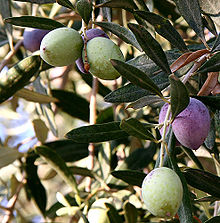
There are over 20 species of olives around the world, but only one (Olea europaea, and its thousands of varieties) is edible and used make oil.  And talk about being productive; olive trees have been reported to live over 2,000 years and still produce fruit!

Reindeer (Caribou)
Sorry boys, you can't pull Santa's sleigh.

Over the years, I've noticed that my joints have more snap, crackle, and pop than a bowl of Rice Krispies.  But the snapping of a reindeer's tendons has nothing to do with age.  Instead, the clicking sound produced by the reindeer's feet help it locate the rest of its herd in the heaviest of snowstorms.  And while both male and female reindeer have antlers, it's only the females that retain them in the winter.  Does this mean that Donner is really....Donna?

No matter what holiday you are celebrating this season, have a wonderful one!  And for you, my fantastic followers, I have a surprise in store in the new year...stay tuned!

Tuesday, December 13, 2011

Migration: It's all a Matter of Perspective

Although in many places December so far hasn't been too cold, there are still plenty of people who are packing up their things and are heading down south for the winter.  There they will escape the nor'easters and Alberta Clippers of the north and instead take refuge in the palm trees, sand, and green grass of the south.  Animals go through migrations too as I'm sure you know, but you'll find that one's definition of "migration" depends on how you look at it.


Most of the time when we think of migration, the first animal that comes to mind is birds, as they fly from cold northern regions to warm southern areas in the fall the reverse route in the spring (I previously posted about fall bird migrations, check it out here).


But it doesn't have to be cold to trigger migration.  For African elephants, they follow the rain.  As their native lands dry from lack of rain, the elephants move to areas that still have green vegetation to eat (the grass really is greener on the other side!).  Once the rainy season begins, the elephants will return to their newly-greened homes.


And food isn't the only reason for migration either.  For the monarch, who doesn't hibernate like the rest of its butterfly cousins, they have to fly nearly 3,000 miles each year to Mexico to escape freezing in the winter.  Others migrate in search of suitable breeding grounds; freshwater rivers for the Chinook salmon and Florida beaches for the loggerhead sea turtle.


Nor is migration always in a north-south orientation.  Elk and mountain goats practice what is called altitudinal migration; they move from higher to lower elevations as the snow begins to fall.


Migrations don't even have to occur over a long period or distance!  Some migrations last only 24 hours, as is the case with the tiny shrimp-like krill that live in the ocean.  Krill migrate 1500 feet daily from their daytime protected depths of the ocean to the surface of the ocean under the cover of night to feed while avoiding the keen eye of predators.


So I guess when you think about it, I could consider my 9:00pm raid on the refrigerator a kind of nightly migration; there's no food on the couch, so I have to move to the refrigerator where there is food.  Now if I could just burn the same amount of calories as a Arctic tern that has just migrated from the north to the south pole...

Sunday, December 4, 2011

A Darker Side of the Holidays: the Christmas Sucker


There are a lot of animals that only seem to come around in the winter.  In my native North Dakota, it was snow buntings (the original "snow birds") and snowy owls.  Here in Pennsylvania, the slate-colored juncos only appear at my feeders when there is snow on the ground.  I have noticed the appearance of an interesting plant though, a presence that is far more...sinister.


This plant is a parasite, feeding on helpless and unsuspecting victims, who only want to get in the holiday spirit. Now I know what many of you are thinking; you're thinking that I'm talking about mistletoe. While it's true that mistletoe is indeed a parasite that sucks life out of its hosts, I'm talking about a plant that targets us. I found a picture of one online...here let me show you:


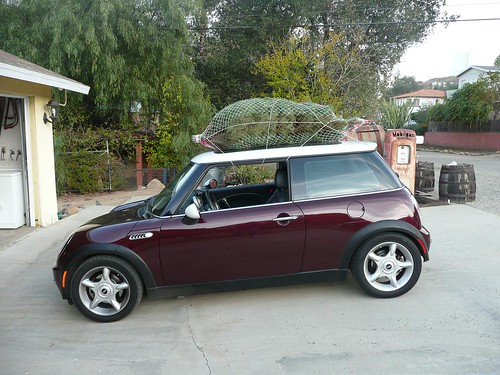
Yes, it's the dreaded Christmas suckers: the Parasitic Pine (Festivus pinus), the Sucking Spruce (Festivus picea), and the Feeding Fir ( Festivus abies).  


This family of trees all share the same feeding characteristics.  Some attach to their host using tendrils resembling twine, and others like the one above use a strong spider-like webbing.  You'll notice that the trees assume an aerodynamic pose before attaching by drawing in their branches and orienting their bodies so that they face trunk-first on their host.  The attachment through tendrils and/or webbing, coupled with an aerodynamic pose allow the Christmas suckers to feed while riding their hosts at speeds in excess of 55 miles per hour (where did you think those extra miles per gallon where going, hmmm?).  Once inside our homes, we can only prevent them from making us their next meal by making offerings on and beneath their boughs.
This family should be safe this year...I think.


I found some more pictures of parasitized vehicles that I want to share in order to educate you on how far-reaching this infestation is.  Here we can see a close up of the twine-like tendrils, attaching the Christmas sucker to its host.


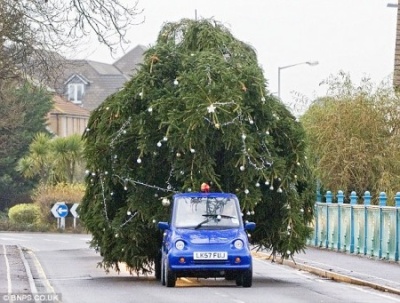
Parasites are only successful if they live off of a host without killing it.  Otherwise the parasite threatens its own existence by eliminating its food supply.  Here we can see that the Christmas sucker selects its host by finding one of comparable size to itself.


However, sometimes the trees get a little over zealous.  


In 2010, this hefty fellow was not only able to find a suitable host, but was then transported to the White House. The White House, people!


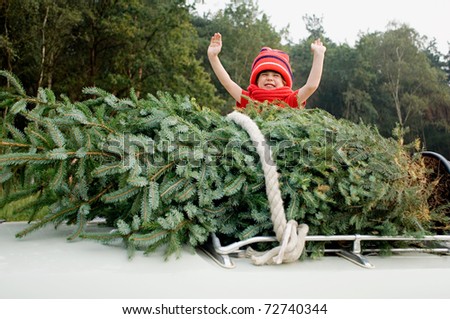
In this photo, a Christmas sucker has resorted to parasitizing a small child. The horror!!
As you can see from the official watermark, I got this from a classified file
 in the Department of Agriculture called "Shutterstock"

This holiday season, keep a keen eye out for the Christmas sucker.  They may look innocent, but that's what they want you to think. But as long as we support one another by giving each other offerings for our trees (often called a "gift exchange") we can make it through this holiday season...alive.